History · Estevanico, 1528–1539
Texas Wasn’t Even Texas When a Moroccan Walked Across It
An enslaved Moroccan reached the Texas coast in 1528—308 calendar years before the Republic. His extraordinary journey, uncertain religious history and the records that refuse to fit a tidy origin story.
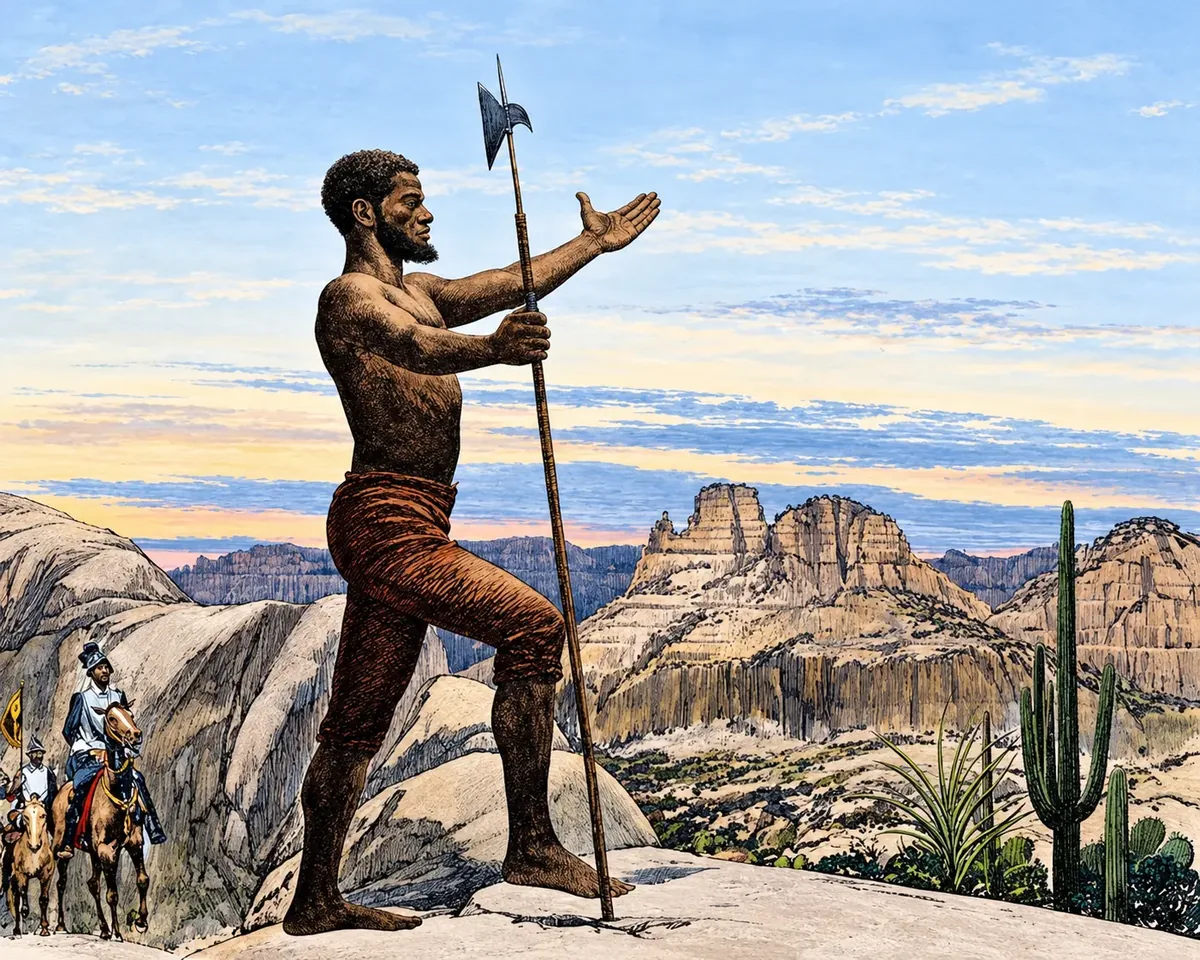
In 1528, an enslaved man from Morocco came ashore on the Gulf Coast of the land now called Texas. His name survives in several forms: Estevanico, Estebanico and Esteban de Dorantes. The Texas African American History Memorial includes him in its account of the state’s earliest recorded African presence. This is not a newly invented origin story. Texas has already put the man in its official commemorative record. [1]
The Republic would not declare independence until March 2, 1836. Statehood followed on December 29, 1845. Set those dates beside 1528 and the distances are striking: 308 calendar years before the Republic, 317 before Texas joined the United States. The political anniversaries are real. So is the much older history they cannot contain. [1][2]
The headline needs one distinction at the outset: the absence of a Republic of Texas did not mean the absence of people, communities or history. Estevanico entered an inhabited world. What makes his story remarkable is not that he found an empty place waiting to become somebody else’s country, but that an African man held in slavery became an important intermediary within a Spanish expedition’s encounters with Indigenous societies. [3]
Milestones, drawn to scale
1528
Estevanico reaches the Texas coast [1]
| Milestone | Year | Calendar years after 1528 |
|---|---|---|
| Estevanico reaches the Texas coast | 1528 | 0 |
| Republic of Texas declares independence | 1836 | 308 |
| Texas joins the United States | 1845 | 317 |
Who was Estevanico?
Donald E. Chipman’s biography for the Texas State Historical Association identifies Estevanico’s home as Azamor, now generally spelled Azemmour, on Morocco’s Atlantic coast. It also records his Christian baptism in Spain before 1527 and his enslavement by Andrés Dorantes de Carranza. Those particulars put a person, a place and a relationship of power behind a name too easily reduced to a colorful explorer’s nickname. [4]
The surname itself carries that power. As the National Park Service explains, “de Dorantes” reflects his enslavement by Dorantes, not a family relationship we should casually assume. To repeat the name without its history is to miss part of the record sitting in plain sight. He was a traveler whose identity has reached us partly through the naming practices of the people who owned and employed him. [3]
An explorer’s biography can make movement sound like freedom: a person decides to leave, follows a route and chooses another destination. Estevanico’s story does not allow that comfortable sequence. He could possess knowledge, exercise judgment and perform essential work while remaining under somebody else’s authority. His skill could make him indispensable without making him free.
Eight years, not a single afternoon in 1528
The 1528 date marks his arrival on the Texas coast, not the completion of every journey later attached to his name. The wrecked Narváez expedition left a small group of survivors whose long passage through the region extended into the following decade. The National Park Service describes Estevanico and three companions—including Álvar Núñez Cabeza de Vaca—reaching Spanish settlements near Culiacán in 1536. [1][3]
That span matters more than a neat line on a souvenir map. Years separate the landfall from the eventual arrival at Spanish settlements. A chart that connects the two can convey chronology, but it cannot turn every uncertain stage into an exact itinerary. Chipman’s account allows more than one possible location for the initial coastal landing. We should not manufacture a precise pin simply because a modern map makes one easy to draw. [4]
The memorial’s account emphasizes Estevanico’s language skills and interpreting work as the survivors moved through southern Texas and northern Mexico. That is a different kind of historical achievement from planting a flag. Communication required other people: speakers, hosts, guides and communities whose knowledge mattered to what happened next. Estevanico belongs near the center of this story, but making him visible should not make everyone he encountered disappear. [1]
Two separate chronologies
One traveler’s journey
More than four centuries, no claimed link
Later institutional histories
- 1950sDallas community later known as Masjid Al-Islam begins with Temple No. 48 [5]
- 1964University of Houston Muslim Student Association established [6]
- 1969Islamic Society of Greater Houston and Islamic Association of North Texas established [7][8]
- 1975Dallas community’s transition toward Sunni Islam [5]
The question about his faith
Was Estevanico Muslim? The available evidence does not establish what he privately believed or practiced during his travels in Texas. His Moroccan background explains why he appears in discussions of Islam’s early connections to the Americas; the TSHA biography also records his baptism as a Christian before the expedition. Neither fact supplies a complete account of his inner religious life. [4]
That is not a reason to discard him from the conversation. It is a reason to resist making him perform a job the surviving evidence cannot support. Birthplace is not a transcript of belief. A baptism recorded in the life of an enslaved person is not permission to invent either a willing conversion or a secret resistance. The gaps do not belong to us to fill with the version that produces the best headline.
There is a further distinction between one person’s presence and a lasting congregation. A traveler arriving in 1528 does not establish five centuries of continuous Muslim worship in Texas. Readers looking for that particular claim can consult our existing Estevanico evidence record. The broader history of Muslim Texas follows separate people, communities and institutions rather than pretending they all descend from one extraordinary castaway.
A compelling history does not need a perfect mascot. Estevanico is interesting precisely because the categories refuse to settle neatly: African and Moroccan, enslaved and highly capable, remembered as an explorer yet known largely through accounts written by others. His life is not improved by flattening those tensions into a certificate of religious membership.
Sent north again
In 1539, Estevanico was sent with the Franciscan Marcos de Niza on a reconnaissance expedition toward the settlements the Spaniards called Cíbola. The National Park Service describes his work ahead of the main party and reports of his death near the Zuni community of Hawikuh. It also emphasizes that the surviving accounts do not resolve every detail of his disappearance. A reported death is part of the history; a confidently reconstructed final scene would go beyond it. [3]
The return north makes the problem of freedom especially sharp. Surviving a disastrous expedition had made his experience valuable. It had not simply handed him control of his future. We can recognize ingenuity without mistaking usefulness to a colonial enterprise for liberation from it. That distinction keeps the human stakes in view when the itinerary threatens to take over the story.
Already in the record, still worth reading
The Texas State Preservation Board’s published text for the African American History Memorial places Estevanico in its opening panel, covering first contact and the Spanish colonial era. The same panel identifies his Moroccan origin, enslavement, 1528 arrival and role as an interpreter. Anyone checking the starting point can read the state’s document rather than take this publication’s word for it. [1]
There is something wonderfully awkward about that. The supposedly surprising detail is not hiding in a forbidden archive; it is sitting in a public record. The task is less to announce that nobody has ever heard the story than to give it enough space to register. A name on a panel becomes more consequential when a reader can connect it to the centuries surrounding it.
A place’s history is not the autobiography of the people who later govern it. The Republic and statehood are chapters, not instructions to begin reading there. Estevanico’s journey changes the scale of the page: the familiar dates remain, but they no longer get to occupy the whole thing.
Centuries later, different communities built a religious life
The next part of this history does not require a fictitious bridge across the intervening centuries. Modern Muslim institutions have their own records and their own beginnings. Putting them beside the sixteenth-century journey shows different layers of Texas history, not an unbroken organization extending from a shipwreck to a contemporary mosque.
Dallas’s Masjid Al-Islam traces its community to the Nation of Islam in the 1950s and Temple No. 48. Its own chronology describes a transition toward Sunni Islam in 1975. It also records something more intimate than a founding date: a combined Eid celebration with international Muslims in a Grand Prairie backyard in 1977. The community’s history includes religious change, local organization and encounters among people whose paths to Islam were not identical. [5]
In Houston, the University of Houston dates its Muslim Student Association to 1964. The Islamic Society of Greater Houston dates its establishment to 1969 and recalls students, young professionals and families gathering for prayers in one another’s homes. In North Texas, the Islamic Association of North Texas also records 1969 as its founding year. These are institutional histories, not dates inferred from a person’s surname or country of birth. [6][7][8]
The domestic scale is worth noticing. A student organization, a gathering at home and a backyard Eid do not look like a grand monument. They are still part of how a religious community becomes a durable local presence. They give history something beyond arrival: meetings, relationships and repeated work. Readers can follow those later institutions through our history feature and mosque and association directory, without confusing a building’s opening with the beginning of every community around it.
Let the older story stay complicated
The temptation is to recruit Estevanico for another clean origin story, only with a different protagonist. That would waste what is most revealing about him. The surviving record gives us an enslaved Moroccan traveler, exceptional interpreting skills, an uncertain religious life and journeys through Indigenous worlds that colonial accounts did not fully explain. The complexity is not an inconvenience to remove before the story can begin. It is the story. [1][3][4]
Texas does not become less interesting when its past refuses a simple cast list. It becomes considerably more interesting. There is room for the Republic without pretending the landscape began in 1836, and room for Muslim history without making an unverifiable claim about a sixteenth-century man’s private prayers. The past does not give a damn about a tidy origin story. We should be grateful for the complication.
Questions readers ask
When did Estevanico arrive in Texas?
Estevanico reached the Texas coast in 1528. His subsequent travels with other survivors continued for years; the National Park Service places their arrival at Spanish settlements near Culiacán in 1536. Arrival and the entire crossing are not the same event. [1][3]
Was Estevanico Muslim?
His religious practice during the Texas journey is not established by these records. TSHA documents his Moroccan origin and Christian baptism before the expedition; those facts do not settle his private beliefs. [4]
How long before the Republic of Texas was that?
The dates 1528 and 1836 are 308 calendar years apart. Texas entered the United States in 1845, 317 calendar years after 1528. These are differences between calendar years, not exact day-to-day intervals. [1][2]
Did his arrival establish a Muslim community in Texas?
An individual’s arrival does not establish a continuing congregation. The modern institutions discussed here have separately documented twentieth-century histories. Their dates should not be presented as proof of uninterrupted continuity from 1528. [5][6][7][8]
Sources
- 1Texas African American History Memorial Monument, Panel 1: “First Contact and the Spanish Colonial Era, 1528–1820” (PDF, page 1) — Texas State Preservation Board · retrieved 2026-10-24 ↩
- 2Texas 175: A Dozen Documents That Made a Difference — Texas State Library and Archives Commission · retrieved 2026-10-24 ↩
- 3Esteban de Dorantes (Coronado National Memorial, updated June 28, 2019) — National Park Service · retrieved 2026-10-24 ↩
- 4Donald E. Chipman, “Estevanico,” Handbook of Texas Online — Texas State Historical Association · retrieved 2026-10-24 ↩
- 5History — Masjid Al-Islam, Dallas · retrieved 2026-10-24 ↩
- 6Student Organizations: Muslim Student Association — University of Houston, A.D. Bruce Religion Center · retrieved 2026-10-24 ↩
- 7About — Islamic Society of Greater Houston · retrieved 2026-10-24 ↩
- 8About us — Islamic Association of North Texas · retrieved 2026-10-24 ↩