Research
Texas Muslim History: The People, Institutions and Records Behind the Story
Early African connections, Black Muslim congregations, immigration, music and civic life: a history of Texas Muslims that keeps the evidence in view.
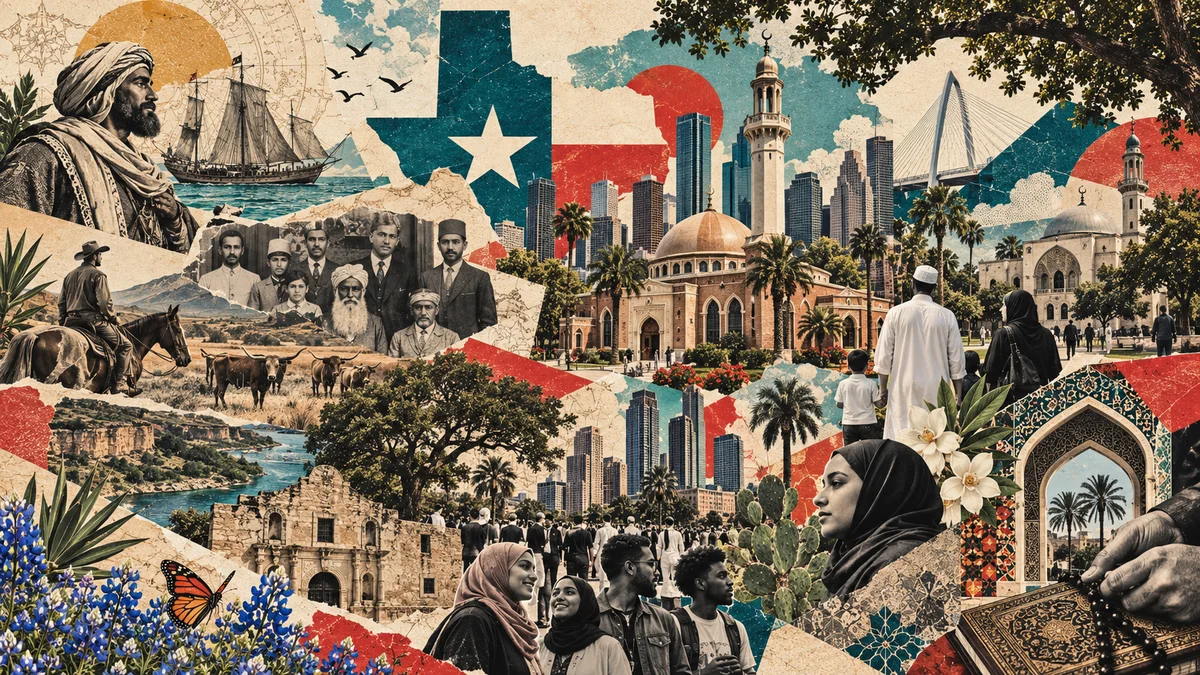
Texas Muslim history is not a single story of newcomers arriving from somewhere else. It includes early African connections, the formation of Black Muslim congregations, changing immigration rules, student communities and the practical work of building places to pray, learn and gather. Some parts of that history are documented through surviving manuscripts and official records; others are preserved in the accounts of particular institutions. The distinctions matter, because a good history should neither erase a community nor improve its credentials by inventing continuity. [1][3][6][7]
The familiar shorthand begins in 1528 and ends with a large present-day population estimate. Between those points lie several different histories, not one uninterrupted institutional line. This article follows those histories through identifiable people and places, while separating a person’s birthplace from religious affiliation, a congregation from a building, and an old estimate from a current count. The object is to describe Muslim life as part of Texas, not to produce a certificate deciding who is allowed to belong here.
1528: Estevanico and the limits of a starting date
Estevanico, also known as Esteban de Dorantes, was an enslaved Moroccan participant in the Narváez expedition. The Texas State Historical Association places his raft’s landfall on or near Galveston Island in 1528 and describes his subsequent travels. The same biography records Christian baptism before the expedition. His presence is an important early African connection to Texas; the cited record does not establish his continuing Muslim observance. [1][2]
That qualification belongs in the history rather than in a footnote designed to escape notice. Neither a Moroccan origin nor a baptism under conditions of enslavement supplies complete access to someone’s inner convictions. It is also a separate question whether an individual’s journey established a continuing community. The date 1528 should not be turned into a claim of uninterrupted Muslim congregational life across five centuries. Our Estevanico evidence record explains that distinction in more detail.
The story should not begin by making the Indigenous inhabitants of the region disappear, either. Estevanico traveled through inhabited places and depended on encounters with people whose histories did not start with the expedition. The National Park Service’s account emphasizes his role as a traveler and intermediary within a colonial enterprise and the limitations of the surviving narrative. He was not simply a modern migrant choosing a new hometown. [2]
Slavery and the wider African Muslim record
There is direct evidence of Muslim life among people enslaved in the United States. The Library of Congress holds Omar ibn Said’s Arabic autobiography, written in 1831. Its account identifies him as a Muslim scholar brought from West Africa to South Carolina in 1807. His manuscript places an enslaved person’s religious knowledge and authorship inside the American historical record, rather than treating Islam as a subject that entered American life only through recent immigration. [3]
Omar ibn Said is national context here, not evidence that he lived in Texas. Nor does the existence of his manuscript justify assigning a precise Muslim percentage to the enslaved population of Texas. A statewide calculation would need appropriate records and a transparent method. The gap is important: slavery constrained what people could preserve and what later historians could recover, but a damaged record is not permission to fill the missing entries with confident numbers.
Ottoman-era migration and the problem with labels
The Texas Almanac describes Lebanese and Syrian migration in the late nineteenth century through households, traders and the communities they established. Many came from territories of the Ottoman Empire. The political geography of departure, however, does not by itself establish religion; these migrations included people of different faiths. A history of Muslim Texans can place this migration in context without calling every Ottoman-origin Texan Muslim. [4]
This is especially important when using early population figures. The Almanac’s 1910 category “Turkey in Asia” concerns origin, not a census of Muslim affiliation. It should not be rewritten as an exact count of Muslims living in Texas. The 1910 evidence check preserves that distinction. It is a small correction with a large consequence: ancestry and faith remain things to document, not synonyms to substitute when a convenient number is wanted.
1924 and 1965: restrictions, reform and different routes to Texas
Federal immigration law strongly shaped who could reach the United States. The national-origin quota system associated with the 1924 law and other exclusionary rules restricted immigration on unequal terms. Later reforms dismantled parts of that structure, and the 1965 legislation ended the national-origin quota system. Describing the intervening decades as a complete halt to all migration from Muslim-majority countries would be too absolute; the legal history includes exceptions and changes before 1965. [5]
Neither period can be reduced to one kind of person. Immigration history concerns distinct routes and categories, not a single movement of interchangeable “Muslim migrants.” It also cannot account for every Muslim already born in this country. Our American and European migration comparison explains why place, period and admission category need to remain visible when broad comparisons are made.
Black Muslim Dallas and the history of Masjid Al-Islam
Dallas’s Masjid Al-Islam traces its beginnings to a Nation of Islam community in the 1950s, known as Temple No. 48. Its institutional account describes the community’s transition in 1975 under the influence of Warith Deen Mohammed toward Sunni Muslim practice. That is a particular congregation’s history, not a claim that every Nation of Islam community followed the same path. [6]
The account also follows the community beyond a founding date: a permanent Harwood Street home, educational activity and a long-running program feeding neighbors. These details matter because they describe religious life as an institution maintained over time. Black Muslim history is not an appendix to an immigration story; this community was developing within the United States through its own religious and civic experience. [6]
A change in theology or organizational affiliation does not mean the earlier community never existed. It means the history requires enough detail to describe both continuity and change. The question “When did the mosque begin?” can refer to a congregation, a particular name, a building or a tradition of worship. Those answers may carry different dates without being contradictory.
Houston, North Texas and the work of building institutions
The Islamic Society of Greater Houston dates its founding to 1969, describing students, professionals and families organizing a shared religious life. Its service records now encompass much more than a place for Friday prayer, including education, charitable assistance and other community functions. This is an institutional account of how a congregation’s needs developed into an organized network; its current service list is not evidence that every program existed at the founding. [7][20]
The Islamic Association of North Texas likewise dates its establishment to 1969. It describes religious, educational and social services through which people maintain community life in the Dallas area. The two organizations should not be treated as interchangeable, and neither represents every Muslim in its metropolitan region. They are documented examples of organization and continuity, not a claim that Texas Islam has one governing institution. [8]
The Islamic Society of Denton records the opening of its mosque in August 1981 and identifies local residents, including students at the University of North Texas and Texas Woman’s University, among those responsible. That date documents a building and community project. It need not be inflated into the first Muslim gathering anywhere in Texas to demonstrate a longstanding local history. [9]
These accounts also explain why a religious landscape cannot be measured only through prominent domes and large campuses. A group may gather before it has a permanent building; an established institution may move or create additional locations. The Texas mosque and association directory therefore separates organizations from the places they operate. A building count, an organization count and a population estimate are not the same dataset.
Modern growth: use the number with its date
The Handbook of Texas records an estimated 421,972 Muslims in 2010. The introduced text of Representative Suleman Lalani’s HCR 18 in 2025 cites an estimated 500,000 Muslims and more than 330 mosques and Islamic centers. These numbers describe the scale attributed to the community in their respective sources. They are not interchangeable measurements, and neither should be introduced as a precise new census conducted in 2026. [10][11]
The proposed resolution is evidence of a public recognition effort and the estimates its author cited. It is not a demographic methods paper or proof that the proposed designation was finally adopted. City-specific counts and national rankings likewise require their own dates and definitions. Our population evidence record lays out the distinction rather than assembling apparently compatible numbers from incompatible sources.
An honest description can recognize growth without supplying a false level of precision. It can also avoid turning growth into an explanation of what individuals believe, how they vote or whether they belong. Population is a measurement question. Political allegiance and personal conduct are different questions that cannot be answered by counting mosques.
Culture, sport and public learning
Hakeem Olajuwon’s Houston career included two NBA championships and Ramadan fasting during the playing season. His public connection to Muslim life extends beyond basketball: the Islamic Dawah Center’s founder’s message describes a place for worship, learning and encounter. The downtown institution is a useful example of a public figure’s connection to enduring local religious infrastructure, rather than a celebrity name placed on an otherwise disconnected list. [12][13]
Qawwali supplies a different cultural connection. Riyaaz Qawwali describes a repertoire rooted in South Asian devotional traditions and an ensemble drawing on multiple cultural and religious backgrounds. Its civic work identifies a Greater Houston collective. It would therefore be inaccurate to label all its musicians Muslim or to erase the interfaith character of the project simply because qawwali is associated with Sufi devotion. [14][15]
There are also collaborations involving people who should not be assigned a Muslim identity at all without evidence. Rice University’s 2015 announcement of its Religion and Hip-Hop Culture course names Anthony Pinn and Bun B as co-teachers and identifies Bun B as a distinguished visiting lecturer. That is evidence of educational work around religion and culture, not proof of Bun B’s religious affiliation or a tenured professorship. [16]
These examples belong together because cultural history includes both Muslim participants and relationships across religious boundaries. It does not require turning every collaborator into a member of the same faith. A performance, a classroom and a mosque each produce different forms of encounter, and each deserves to be described in its own terms.
Muslim Texans in civic and intellectual life
Suleman Lalani and Salman Bhojani won election to the Texas House in 2022 and entered the Legislature among its first Muslim members in 2023. Their official biographies describe different professional and local-government backgrounds. Their election marks a change in representation, not the moment Muslim Texans first entered civic life. The institutions and service programs described earlier were already part of the state’s public landscape. [17][18]
Contemporary religious scholarship and public communication are another part of that landscape. Omar Suleiman’s account of Yaqeen Institute’s early years describes its research and educational project. That first-party institutional history is useful for understanding the project’s aims; it does not make one scholar the spokesperson for every Texan who practices Islam. The history of a diverse community should leave room for different institutions, traditions and disagreements. [19]
Public recognition should not reduce Muslim Texans to a parade of exceptional achievers. The community also includes ordinary families, employees, students, retirees and people facing the same daily practical problems as their neighbors. Institutions are maintained by repeated work that seldom produces a famous biography: collecting donations, organizing lessons, preparing meals and keeping a building open. A useful archive should make room for those records as well as celebrated names.
Selected chronology, with the distinctions retained
| Period | Milestone | Source |
|---|---|---|
| 1528 | Estevanico reaches the Texas coast with survivors of the Narváez expedition; his continuing religious practice is not established here. | Sources 1–2 |
| Late nineteenth century | Lebanese-Syrian migration from Ottoman territories; origin is not a religious count. | Source 4 |
| 1924 / 1965 | Restriction through national-origin quotas, followed by their removal through federal reform. | Source 5 |
| 1950s / 1975 | The Dallas community later known as Masjid Al-Islam develops from Temple No. 48 and transitions toward Sunni practice. | Source 6 |
| 1969 | ISGH and IANT date their establishment to this year. | Sources 7–8 |
| August 1981 | The Islamic Society of Denton opens its mosque. | Source 9 |
| 2010 | TSHA’s dated estimate: 421,972 Muslims. | Source 10 |
| 2022–2023 | Lalani and Bhojani are elected and enter the Texas House. | Sources 17–18 |
| 2025 | Introduced HCR 18 cites 500,000 Muslims and more than 330 mosques and centers. | Source 11 |
How to use this history
A reader checking an argument can follow the links to the records behind each date, then decide whether the evidence supports the claim being made. A journalist can distinguish an institutional account from an independent study. A family or congregation can use the framework to identify material worth preserving: newsletters, photographs with dates and credits, meeting records, oral histories and building documents. An uncaptioned image or an undated memory can be a research lead without yet being a verified historical fact.
Texas Muslim will develop this history through documented additions rather than by attaching a newer year to old statistics. Related evidence checks address birthplace and religious identity, the scope of religious land-use protections and the meanings of Sharia. The welcome essay, “As-salamu alaykum, Y’all.”, supplies Omar Afra’s personal account of the same broader subject: Muslim and Texan identities lived together, rather than treated as competing claims to the same place.
Method and scope
A synthesis of institutional histories, the Handbook of Texas, archival sources and official public records. Institutional accounts are identified as such. Historical connections are distinguished from demonstrated continuity; religious identity is not inferred from birthplace. Population estimates retain their source years. This is a reference history, not a complete census or an exhaustive list of Muslim Texans.
- Geographic scope
- Texas, with explicitly labeled national historical context.
- Temporal scope
- Early connections in 1528 through modern institutions and sources checked in September 2026.
Sources
- 1Estevanico, Handbook of Texas — Texas State Historical Association · retrieved 2026-09-21
- 2Esteban de Dorantes — National Park Service · retrieved 2026-09-21
- 3Library of Congress acquires rare autobiography of an enslaved Muslim scholar, January 15, 2019 — Library of Congress · retrieved 2026-09-21
- 4Lebanese-Syrian Texans — Texas Almanac · retrieved 2026-09-21
- 5Asian American and Pacific Islander immigration records and historical overview — U.S. National Archives · retrieved 2026-09-21
- 6History of Masjid Al-Islam, Dallas — Masjid Al-Islam · retrieved 2026-09-21
- 7About ISGH — Islamic Society of Greater Houston · retrieved 2026-09-21
- 8About IANT — Islamic Association of North Texas · retrieved 2026-09-21
- 9About us — Islamic Society of Denton · retrieved 2026-09-21
- 10Muslims, Handbook of Texas — Texas State Historical Association · retrieved 2026-09-21
- 11HCR 18, introduced text, 89th Legislature, 2025 — Texas Legislature · retrieved 2026-09-21
- 12Hakeem Olajuwon, NBA legend profile — NBA · retrieved 2026-09-21
- 13Founder’s message — Islamic Dawah Center · retrieved 2026-09-21
- 14Ensemble and repertoire — Riyaaz Qawwali · retrieved 2026-09-21
- 15Civic engagement — Riyaaz Qawwali · retrieved 2026-09-21
- 16Rice launches Religion and Hip-Hop Culture online course, February 2, 2015 — Rice University · retrieved 2026-09-21
- 17Representative Suleman Lalani — biography — Texas House of Representatives · retrieved 2026-09-21
- 18Representative Salman Bhojani — biography — Texas House of Representatives · retrieved 2026-09-21
- 19Thank you for three years, 2019 — Yaqeen Institute · retrieved 2026-09-21
- 20Services — Islamic Society of Greater Houston · retrieved 2026-09-21