Faith explainer
Jesus (PBUH) and Mary in the Qur’an: A Christian Neighbor’s Guide
Muslim reverence for Jesus (PBUH) and Mary is explicit in scripture, alongside theological disagreements that deserve equally honest explanation.
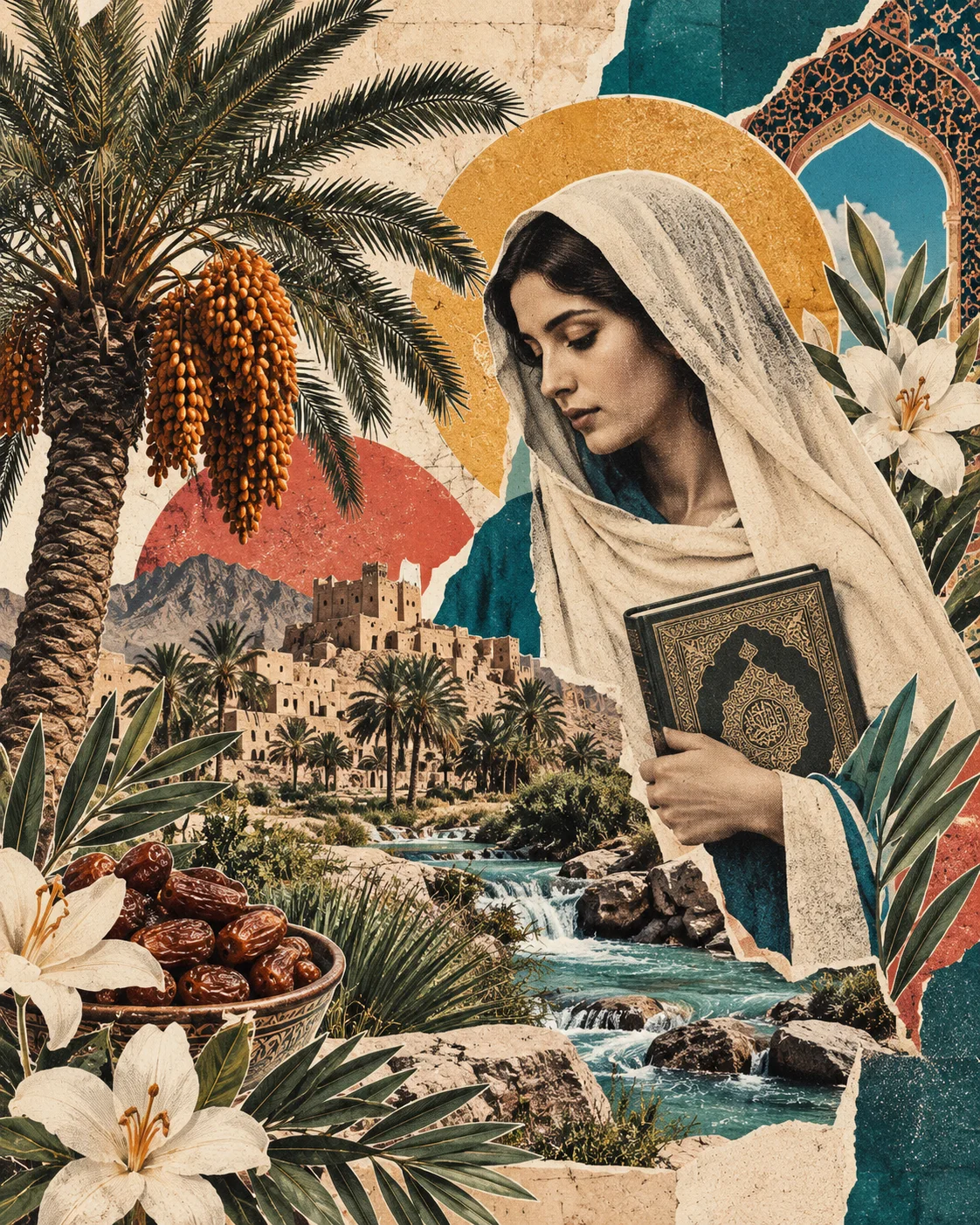
A Christian opening the Qur’an for the first time may be surprised by how much is recognizable. Mary is not marginal. Jesus (PBUH) is not dismissed as a stranger to revelation. The text describes his extraordinary birth, his status as Messiah and messenger, and his relationship to earlier scripture. These connections belong to the source, not merely to modern interfaith courtesy.[1][2]
They do not mean Islam and Christianity make the same theological claims. Muslims revere Jesus (PBUH) without worshipping him as God. The Qur’an challenges doctrines central to much of Christianity. A useful introduction must preserve both genuine reverence and consequential disagreement. Our guide to the same-God question explains why shared reference does not mean identical doctrine.
Mary is explicitly honored
In 3:42, angels address Mary as selected and purified, with exceptional standing among women. Mustafa Khattab’s Clear Quran translation includes “chosen you over all women of the world.” This is not casual acknowledgment; it places Mary within an account of devotion and divine favor.[1]
Chapter 19, Maryam, gives an extended narrative associated with her, including withdrawal, announcement of a son, childbirth’s distress and her community’s response. The passage should be encountered as a narrative, not only as isolated sentences chosen to demonstrate agreement with another scripture.[2]
The relationship offers common ground without proving the Qur’anic and Gospel accounts match in every detail. Religious texts can address related figures for different narrative and theological purposes. Recognizing that relationship is more accurate than asserting either total identity or total separation.
The title Messiah
In 3:45, the announcement to Mary identifies her son as the Messiah and presents him as honored in this world and the next. Isa is the name commonly used for Jesus (PBUH) in Muslim speech. The language difference does not mean Muslims discuss an unrelated person.[3]
The title should not be assumed to carry every doctrinal conclusion a Christian reader associates with it. Words are interpreted within theological frameworks. The Qur’anic use of Messiah coexists with the understanding of Jesus (PBUH) as messenger rather than divine person. Explaining a shared title and differing interpretation does not require suggesting either side uses it insincerely.
The text also associates Jesus (PBUH) with extraordinary signs by God’s permission. That qualification matters: the acts point toward divine power rather than an independent divine status for the messenger. Read the passage on its terms before recruiting it into an argument it does not make.[4]
Service, prayer and kindness
In the Maryam narrative, Jesus (PBUH) speaks as an infant. The Clear Quran renders the beginning of 19:30, “I am truly a servant of Allah.” Following verses connect the account with scripture, prophethood, prayer, charity and kindness to his mother.[5]
These are claims made by the Qur’an. This publication explains what scripture says; it does not assert that modern historical methods independently verify a miraculous event. Distinguishing the two protects both the integrity of belief and the accuracy of the article.
The account also complicates the claim that Muslim reverence concerns only obedience to power or hostility to outsiders. Its vocabulary includes service and care. This does not prove every Muslim institution embodies those values. It establishes their presence in the scriptural portrait, which should not disappear from a fair description.
Genuine theological differences
Qur’an 4:171 addresses the People of the Book, describes Jesus (PBUH) as a messenger and rejects the Trinity. This should not be softened into a claim of complete agreement. Muslims and Trinitarian Christians disagree about the nature of Jesus (PBUH) and how divine unity is understood.[6]
The treatment of crucifixion in 4:157–158 is another major difference. Its language disputes the claim that Jesus (PBUH) was killed and crucified in the way asserted by his opponents, and speaks of God raising him. Interpretations have their own histories, but a general guide should acknowledge the contrast with Christianity’s central crucifixion and resurrection account.[7]
An introduction loses credibility by hiding differences to produce a pleasant conclusion. Respect does not require agreement. Disagreement does not require depicting another community as unable to understand its own beliefs. People can discuss the same figure with distinct convictions while recognizing one another’s sincerity.
The word Allah and the honorific PBUH
Allah is the Arabic word for God, also used by Arabic-speaking Christians. Leaving it untranslated can make an English-speaking reader hear a greater distance than the language creates. The important theological differences concern beliefs about God, not the existence of an Arabic noun.[8]
Muslim devotion distinguishes God from the messenger. PBUH means peace be upon him and expresses reverence for prophets in this publication’s prose. It is not a statement of divinity. We use it for Jesus (PBUH), Muhammad (PBUH) and other prophets, while preserving direct quotations and source titles.
A reader does not have to adopt that convention to understand why it matters to the publication. Voluntary respectful language is not a demand that public discussion follow one religion’s devotional rules. The distinction between editorial choice and compelled belief should remain clear.
Reading passages together
Start with the verse and surrounding narrative. Identify the translator when exact wording matters. Distinguish scripture from commentary and from a contemporary speaker’s conclusion. A short quotation can introduce a subject, but cannot bear every claim about another religion.
For example, Mary’s honored status does not establish that every Muslim society has treated women equally. A passage about kindness does not erase a believer’s abuse. Equally, abuse does not remove the passage from scripture. Text, interpretation and conduct must stay distinguishable for criticism to be more than selective illustration.
Apply the same standard to Christianity. Do not assign a verse a meaning only because it helps one side win. Ask how serious interpreters understand it and where disagreements remain. Curiosity is more productive when it is not merely a pause before delivering a verdict.
Recognition without conversion
A Christian Texan can learn of Muslim reverence for Jesus (PBUH) and Mary without abandoning Christian belief. A Muslim can explain that reverence without pretending to affirm the Trinity. The encounter needs no fabricated agreement to be worthwhile.
These passages offer a better beginning than the claim that Islam stands wholly outside the religious history many Texans recognize. They show a tradition speaking about familiar figures in its own voice. The shared history and differences are both real. Understanding them makes neighbors easier to know and arguments easier to conduct honestly. It also deprives the claim that Muslims simply despise Jesus (PBUH) or Mary of the scriptural support it would need.
Translation note: The two brief quotations are from Dr. Mustafa Khattab’s The Clear Quran as displayed on Quran.com. Other descriptions are explanatory paraphrases. Scriptural claims are identified as such, not presented as independently established historical events.