From the Founder
The Muslim Takeover of Texas: A Concern Best Addressed With 5th Grade Arithmetic
Apparently, our neighbors believe we have a centuries-long plan to conquer Texas. Respectfully, this theory has problems with arithmetic, logistics, and motive. We love Texas. Don't be silly.
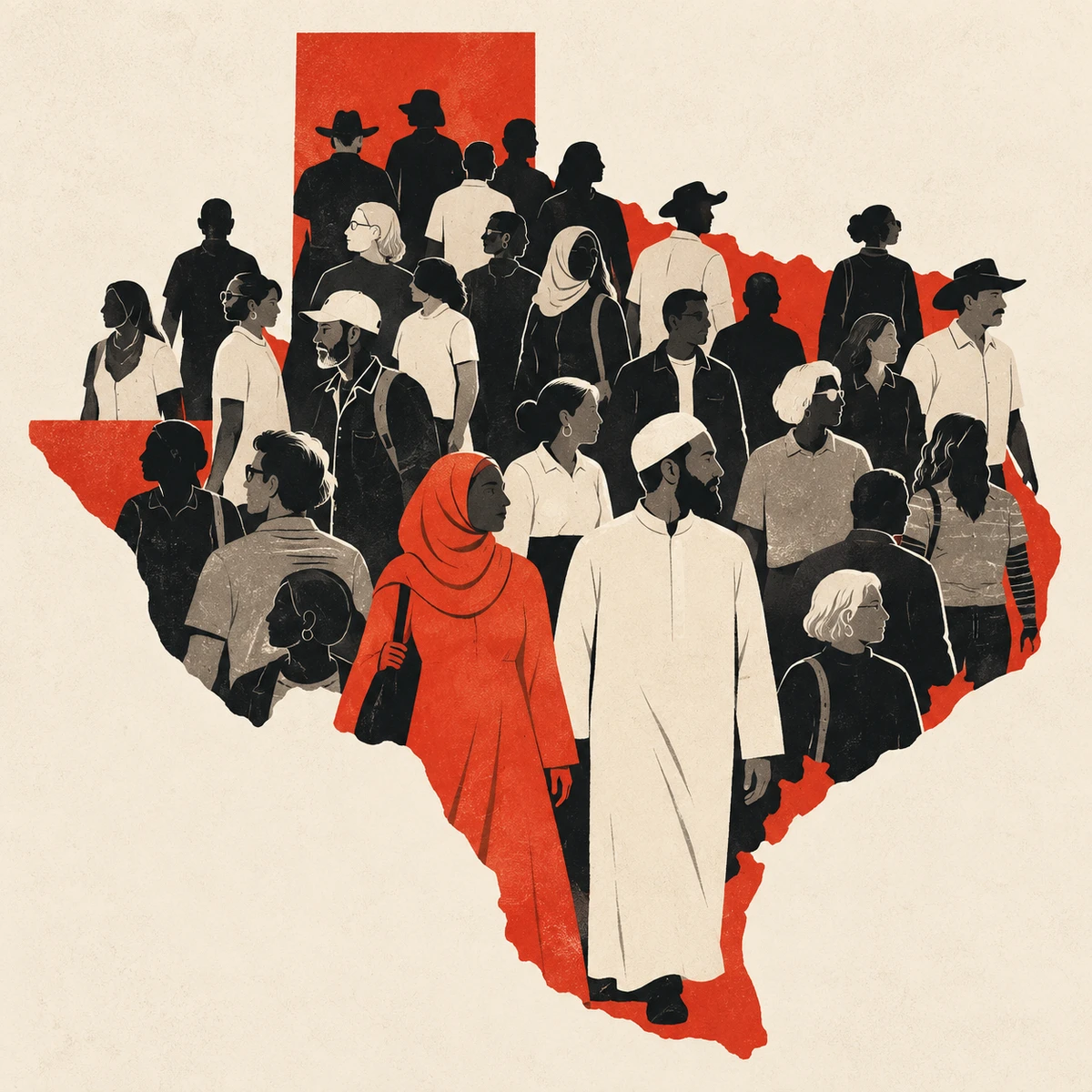
There is a courteous Muslim way to respond to the suggestion that we are taking over Texas: Dear neighbor, someone has taken considerable liberties with your imagination. Before you surrender the state, sell that bass boat, or declare a provisional State government led by Matthew Mcconaughey, perhaps we could look at a few numbers. The situation may call for a calculator before it calls for a militia.
We understand that a frightening video can be persuasive. Add ominous music to footage of a mosque, cut to a politician looking concerned, and suddenly a building with a parking lot becomes the forward operating base of a civilizational offensive. But the footage establishes that Muslims have a building. The rest requires evidence. With respect, a crescent on a roof is doing an extraordinary amount of work in this argument.
First, that math ain't mathing.
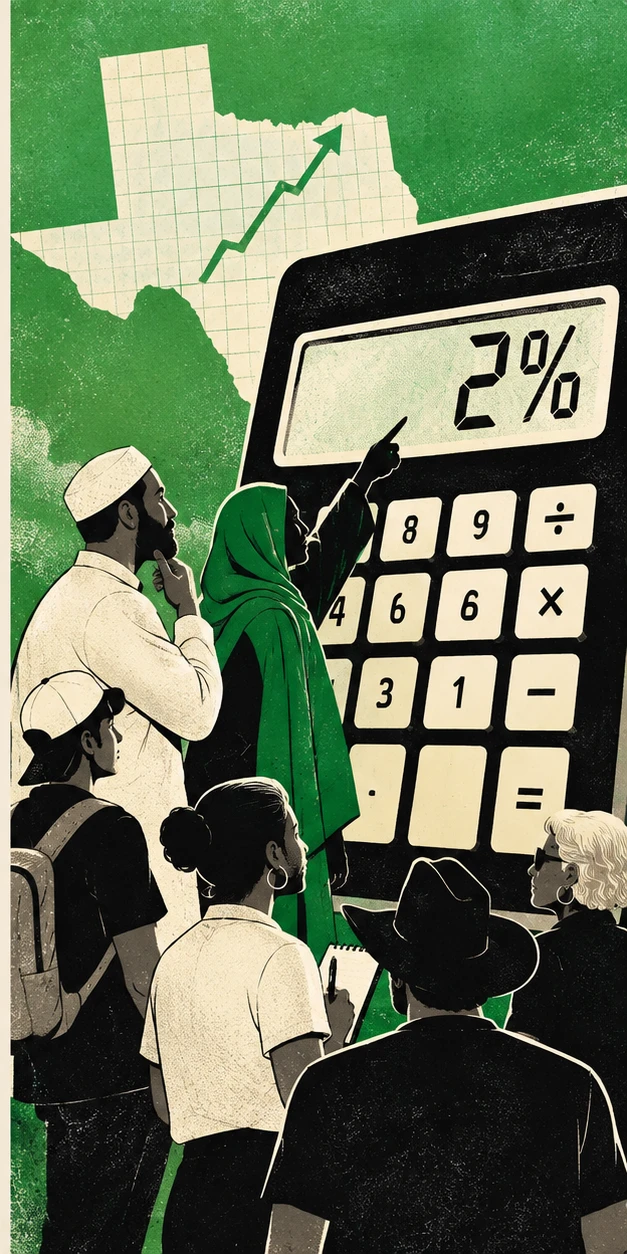
Pew Research Center’s 2023–24 Religious Landscape Study estimates that 67% of Texas adults identify as Christian, 26% are religiously unaffiliated, and approximately 2% identify as Muslim. These are rounded survey estimates of adults, not a census count of every Texan. Nevertheless, the scale is clear: roughly two Muslim adults for every hundred adults statewide.
For a simple illustration, imagine 100 people: two Muslims and 98 people who are not Muslim. Double the Muslim population while holding everyone else constant, and you have four Muslims among 102 people—about 3.9%. You have doubled a community without coming remotely close to a majority. This is an illustration, not a forecast. Its purpose is to explain why “growing rapidly” and “taking over” are different claims.
A minority can certainly exercise political influence. Numbers alone cannot settle every question about power. But anyone alleging a takeover still needs to identify an organization, a mechanism, an actual exercise of authority, and evidence connecting them. A mosque, a Muslim candidate, and a halal restaurant do not become a coordinated operation because somebody put them in the same slideshow.
Testset’s “It’s True: Islam Is Taking Over Texas — At This Rate Sometime Around the Year 2347” gives this mismatch the satirical treatment it deserves. Its central observation is sound: a small population can grow substantially while remaining a small population. We should keep the distant date in the realm of satire, however. Forecasting a religious majority requires explicit assumptions about births, deaths, migration, religious switching, and everybody else’s population. A headline cannot do all that homework by itself.
It is also worth remembering that the U.S. census does not collect religious affiliation. Figures from different surveys and religious censuses can measure different things. If we are inviting people to fifth-grade arithmetic, we should arrive with our own pencils sharpened.
Don't fear Shakira Law, brah.
The national picture offers another useful reality check. Pew’s latest landscape study found that Christian identification among U.S. adults fell from 78% in 2007 to 62% in 2023–24, while the religiously unaffiliated share increased from 16% to 29%. Muslim adults accounted for 1.2% nationally in that survey. These are national figures, distinct from the Texas estimates above.
That does not describe a country exchanging church pews for prayer rugs. It describes a substantial long-term movement away from religious affiliation. And because accuracy should survive contact with a good punch line, Pew also found that the Christian share had been relatively stable between 2019 and 2024. The story is more complicated than either an unstoppable Muslim advance or an uninterrupted Christian collapse.
If a congregation is worried about its future, understanding why people leave organized religion would seem a more productive exercise than investigating whether the family down the street has suspiciously ambitious Ramadan decorations. Blaming Muslims for every change in American religious life is convenient. It saves everyone the trouble of asking difficult questions about their own institutions.
They're selling y'all a tall tale.
The rhetoric deserves scrutiny because it has traveled well beyond an uncle forwarding things before breakfast. On January 30, 2026, Lieutenant Governor Dan Patrick’s interim legislative charges assigned the Senate State Affairs Committee a topic titled “Preventing Sharia Law in Texas.” The document specifically directed examination of the proposed EPIC City development and whether associated entities were violating state or federal law.
Investigating a specific allegation is legitimate. Establishing a violation requires evidence. Neither an investigation nor the language used to announce it proves that a religious community is attempting to seize governmental authority. Those distinctions are especially necessary when the people announcing the danger also benefit politically from appearing to defeat it.
In May, Senator John Cornyn’s own website described EPIC City as an attempted “Sharia Law compound.” That is his characterization, not an established finding adopted here. But consider the rhetorical upgrade: call something a development and people ask about drainage; call it a compound and suddenly everyone thinks they need binoculars.
We can scrutinize housing discrimination, financing, land use, or any other concrete concern without assigning collective guilt to Muslims. Indeed, doing so is how a competent government should operate. Identify conduct. Apply the law. Produce findings. The presence of a mosque should not relieve anyone of those responsibilities.
If you had not noticed, ahem, Muslims don't exactly agree on everything.
The takeover theory also assumes a degree of Muslim coordination that would astonish anyone who has tried to organize a community dinner.
Pew’s research on Muslim Americans describes a population with no single racial or ethnic majority and substantial differences in religious commitment. Some Muslims are highly observant; others say religion is not important in their lives.
Political uniformity is equally elusive. A separate Pew analysis of Muslim political attitudes finds positions overlapping with both major parties and a shrinking Democratic advantage. “Muslim” describes a religious identity, not a party whip with supernatural attendance records.
This does not mean every Muslim organization is admirable, every Muslim politician deserves your vote, or every Muslim’s ideas are beyond criticism. Please scrutinize us. We have bad arguments and disappointing leaders like everybody else. But criticize the person, organization, or proposal you can actually identify. Do not turn several million different people into a single imaginary defendant.
We love Texas. Duh.
There is another problem with the conquest story: it assigns us a motive without asking.
For those of us who chose Texas, the attraction was Texas. For those born here, it is home. We can like the space, the opportunity, the stubborn independence, the family networks, and the extraordinary confidence with which a Texan will describe a three-hour drive as “right down the road.” We can participate in the place without secretly preparing to abolish it.
Liking Texas does not require pretending every policy is wise or every politician is a blessing. Complaining about the government is an established local activity. A Muslim criticizing a governor is exercising the same civic muscle as a Christian criticizing a school board. Neither needs to be interpreted through a counterintelligence briefing.
And in a state where an ordinary conversation can become a lengthy discussion of somebody’s firearms collection, the idea that your Muslim neighbors have selected armed conquest as a practical weekend project is an especially imaginative flourish. But the deeper answer is simpler: we want lives here. Families, work, worship, friendships, decent schools, and perhaps an electrical grid that does not require quite so much personal prayer.
We also love the U.S. Constitution. They got that freedom of religion thing right from the jump.
Fortunately, we do not need to improvise a settlement. Article I, Section 6 of the Texas Constitution protects freedom of conscience and states that “no preference shall ever be given by law to any religious society or mode of worship.” That sentence does not include an exception for religions your neighbor finds unfamiliar.
The First Amendment’s religion clauses likewise protect religious exercise and restrict government establishment of religion. Their application to the states means this framework matters in Texas, too. Religious liberty protects a Muslim’s worship while providing constitutional limits against governmental imposition of religion.
That is the arrangement worth defending. Nobody should acquire the power to impose religious observance on unwilling neighbors. Nobody should lose the freedom to practice a religion because those neighbors dislike it.
Our rights also do not depend on remaining numerically reassuring. Muslims deserve equal treatment at 2%, and would deserve it at a higher percentage. Population figures answer demographic claims. They do not determine who qualifies for constitutional protection.
Also, Have You Met Texas?
Let us entertain the premise for a moment. Muslims, approximately 2% of Texas adults, have supposedly decided to take over Texas. Texas. A state where “Come and Take It” is practically a decorating theme. A place where asking someone about their guns can cost you the remainder of the afternoon. Apparently, this tiny religious minority has surveyed the situation and concluded that what its already crowded calendar needs is a confrontation with the entire Lone Star State. Respectfully, who prepared this feasibility study?
For some perspective, the Texas Department of Public Safety counted 1,416,121 active handgun license holders as of December 31, 2025. That is a count of license holders, not all gun owners or all firearms. Texas also allows eligible people to carry handguns without a license. Whatever else you believe about this state, it has not been sitting around defenseless, waiting for someone to arrive with a subdivision proposal and assume command.
The same political imagination that depicts Texas as an indomitable fortress apparently believes it could fall to a mosque with adequate parking. Which is it, neighbor? Are we discussing a fiercely independent population that distrusts instructions from Washington, Austin, and occasionally its own homeowners association—or a population about to accept an unsolicited change of government from the local Islamic center? Texas cannot agree on beans in chili. Getting everybody to take religious instructions would seem an ambitious next assignment.
The theory becomes even stranger when you remember that Muslim Texans are Texans, too. The imaginary battle line does not run neatly between Muslims and everyone who owns a pickup, values constitutional rights, or enjoys a trip to the shooting range. Religious identity does not sort people into opposing armies. The takeover story has to invent those armies before it can frighten you with the battle.
And what, exactly, is the supposed objective? If “taking over” means voting, opening halal butchers, buying overpriced homes in Dallas, building places of worship in SW Houston, and occasionally winning an election, then we have identified what we like to call......citizenship. If it means physically subjugating Texas, we have identified a screenplay that needs several more drafts and some hallucinating to make sense.
We like living here. We have to slog our way to work in the morning, children to drive to football / dance / choir practice, aging parents to care for, and bigger fish to fry that are considerably more alarm than the mosque down the road where Unlces gather to complain about their wives. You are welcome to disagree with our theology. But before accusing us of planning the conquest of Texas, please explain how you are not using science-fiction to make it make sense. Because it does not. Not even a little. It is categorically bonkers.
A courteous request for better evidence.
Muslims have good reasons to approach this conversation with restraint. Quran 16:125 calls for wisdom, good counsel, and debate conducted in the best manner. We can honor that instruction while asking an unreasonable claim to meet a reasonable standard. Patience does not require nodding along to nonsense.
So, dear neighbor: name the law you believe is being replaced. Identify the authority supposedly being seized. Read the original proposal. Distinguish an allegation from a finding. Ask whether the equivalent activity would frighten you if the building had a steeple. If there is a real violation, bring the evidence. If there is a policy dispute, let us have it.
But if the case consists of a growing community, a visible mosque, and a politician warning that only he can save you, a little skepticism would be healthy. You are being asked to interpret ordinary people making a home as evidence of a hostile operation. That is a substantial accusation to rest on the discovery that your neighbors exist.
We like Texas. We intend to participate in it. And with all due respect, the takeover theory needs considerably more homework.
Sources
- 1Pew Research Center’s 2023–24 Religious Landscape Study
- 2Testset’s “It’s True: Islam Is Taking Over Texas — At This Rate Sometime Around the Year 2347”
- 3U.S. census does not collect religious affiliation
- 4interim legislative charges
- 5Senator John Cornyn’s own website
- 6Pew’s research on Muslim Americans
- 7Pew analysis of Muslim political attitudes
- 8Article I, Section 6 of the Texas Constitution
- 9First Amendment’s religion clauses
- 10application to the states
- 11Texas Department of Public Safety counted 1,416,121 active handgun license holders as of December 31, 2025
- 12carry handguns without a license
- 13Quran 16:125
About the author
Omar Afra is a Houston-based publisher and the founder and editor of Texas Muslim. He publishes Testset and Live Index and founded Free Press Houston.