Atlas · guide
Muslim Austin: a Central Texas guide to institutions and services
From student-centered Nueces Mosque to North Austin, Manor Road, Cedar Park and the cemetery in Dale: history and practical connections.
Edited by Omar Afra · Published · Updated
Sources checked 2026-09-22. Reference years are shown with historical figures.
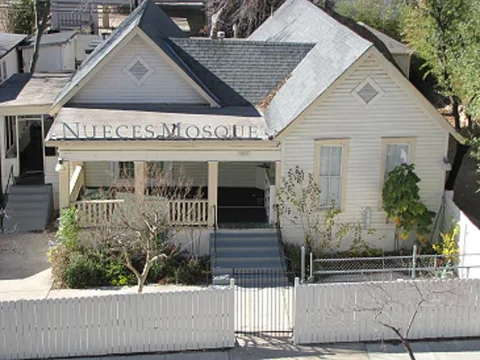
Muslim life in the Austin area is distributed across institutions with different histories and functions: a student-centered mosque near the University of Texas, a longstanding center on Manor Road, the North Austin Muslim Community Center, and facilities beyond the city in Cedar Park and Dale. Treating them as one generic “Austin mosque” would obscure both the geography and the services people actually need. [1][2][3][4][5]
This guide uses Central Texas as a practical frame rather than a statistical metropolitan boundary. It keeps the named city or location attached to each institution, distinguishes schools from weekend classes and campus programs, and points readers to official sources for current arrangements. It does not infer a current Muslim population from the number of organizations listed.
The regional starting points
| Institution or resource | Location | Useful starting purpose |
|---|---|---|
| Nueces Mosque | 1906 Nueces Street, Austin | Student-centered worship, learning and community programs. [1] |
| Islamic Center of Greater Austin | 5110 Manor Road, Austin | Worship and community services. [2] |
| Austin Peace Academy | Manor Road, Austin | Full-time school information and admissions contact. [6] |
| North Austin Muslim Community Center | 11900 North Lamar Boulevard, Austin | Worship, education and community-service programs. [3] |
| Islamic Center of Brushy Creek | 1950 Brushy Creek Road, Cedar Park | Community mosque and educational programs outside Austin proper. [4] |
| ICGA cemetery information | 1920 County Line Road, Dale | Burial-location and provider-coordination information. [5] |
| UT Austin campus resource | University of Texas at Austin | University organization listings and student-resource links. |
The addresses are orientation points checked against the linked public information, not a guarantee that a particular program is taking place there today. Worship, a class, an office appointment and a burial arrangement can use different contacts. The operator’s current page remains the appropriate source for a visit.
A chronology built from distinct institutional milestones
The Islamic Center of Greater Austin dates its establishment to March 1977. NAMCC describes organizing in 1990, initially through gatherings in a home, followed by the opening of its North Lamar facility in 1996. These histories show institutions developing through volunteer organization before the present buildings and programs were fully established. [2][3]
Austin Peace Academy’s history begins in 1997, with an initial preschool and kindergarten group at Nueces Mosque before moving to Manor Road that year. The school records a name change in 2003 and describes its subsequent expansion through high school. Brushy Creek’s center gives July 2007 as its establishment date. These are local histories that should not be collapsed into one citywide founding story. [6][4]
| Date | Institution | Event being dated |
|---|---|---|
| March 1977 | ICGA | Organizational establishment. [2] |
| 1990 | NAMCC | Early community organizing. [3] |
| 1996 | NAMCC | Opening of its North Austin facility. [3] |
| 1997 | Austin Peace Academy | Initial school operation and move to Manor Road. [6] |
| 2003 | Austin Peace Academy | Adoption of the current school name. [6] |
| July 2007 | Islamic Center of Brushy Creek | Establishment of the Cedar Park institution. [4] |
For the larger historical setting, use Texas Muslim History. A chronology is most informative when it identifies whether the event concerns a community, an organization, a program or a property, rather than using “founded” to mean all four.
Nueces and the university connection
Nueces Mosque presents itself as a community serving students alongside families and other participants. Its current public site connects readers to religious learning and community programming at its Nueces Street location. For someone arriving at UT Austin, it can be a point of contact with Muslim life beyond a classroom or residence hall, but it should not be confused with a university department. [1]
That organizational distinction is useful. A university-recognized student group has a campus relationship; a community mosque has its own governance and access arrangements. A program shared by students and community members does not turn the mosque into university-owned property. The UT Austin resource page links to official university organization information so readers can follow the correct institutional route.
Before relying on a student calendar, check that the listing refers to the present term. Orientation programs, weekly meetings, building access and holiday arrangements can differ. Use a current organization contact for a question about accommodations or campus facilities rather than asking a community directory to stand in for university guidance.
Manor Road: worship and school history
ICGA and Austin Peace Academy make Manor Road an important institutional point in this guide. Their shared geography does not make their functions interchangeable: a worship inquiry belongs with the center, while enrollment, school records and classroom support belong with the school. The academy’s history provides an unusually useful account of how a small early program developed into a broader educational institution. [2][6]
For school comparison, use the Austin Peace Academy record and then the school’s current admissions material. Ask which grades are offered in the coming academic year, how religious and general academic instruction are organized, and which support services are available. A published historical accreditation milestone is not a substitute for checking present accreditation and the exact campus or program it covers.
Weekend religious instruction deserves a separate inquiry. It may serve children enrolled in public or other private schools and can have a different calendar, fee structure and age range. Counting such a program as another full-time Islamic school would obscure the options rather than expand them.
North Austin and Cedar Park
NAMCC’s official history links its present institution to home-based organizing and a later dedicated facility. Its current organizational description includes worship, educational and charitable programs. The historical sequence is valuable because it connects today’s institution to the practical work of building a community over time, rather than presenting it as a building that appeared fully formed. [3]
The Islamic Center of Brushy Creek supplies a separate point of reference in Cedar Park, publishing community activities, educational offerings and links to other services. The municipality matters: this is not an additional address inside Austin’s city limits. For a traveler, student or family, the relevant question is which institution and program is appropriate—not which headline uses “Austin” most broadly. [4]
A good regional directory should therefore preserve both a service area and a physical location. It can connect Cedar Park with an Austin-area guide while still making the address clear. This is the same distinction the Almanac applies when comparing municipal, county and regional statistics.
Funeral coordination and the Dale cemetery
ICGA publishes burial and funeral-service information and identifies its cemetery at 1920 County Line Road in Dale. The cemetery is not at the Manor Road center. A family may deal with one organization while traveling between several locations for preparation, prayer and burial. [7][5]
The first useful question is who is coordinating the complete arrangement. Ask that provider which facilities are involved, what documents it needs, how transportation is arranged and which contact handles the cemetery. The funeral guide provides a general orientation, while the cemetery index helps distinguish a burial site from a mosque or a funeral-service referral.
This page does not promise same-day burial, quote fees or describe a facility as available without confirmation. Those questions depend on the particular circumstances and the provider’s current arrangements. The role of the Atlas is to make the institutional connections visible before someone has to navigate them under pressure.
Visiting or learning for the first time
A reader unfamiliar with mosque life can begin with the mosque glossary, then contact the chosen center about visitor arrangements. Explain whether the interest is a tour, a class or observation of worship. Ask about the appropriate entrance, clothing expectations, photography and the best time to arrive. This is practical courtesy, not a test of prior religious knowledge.
Likewise, a parent seeking classes or a student seeking community should ask about the program itself rather than assume that every mosque offers the same instruction, language or schedule. The linked institutions describe different combinations of services. Their differences are part of what makes a city guide useful.
What the population evidence can support
No precise current Austin-area Muslim population is asserted here. A count for Travis County would not automatically cover Cedar Park or the wider region; an institution’s participant estimate would not necessarily count residents within the city boundary. The population guide explains those distinctions, and the source ledger provides a recordkeeping method for anyone building a local dataset.
The documented history and locations are already substantial evidence of a varied regional community. Their usefulness does not depend on attaching a speculative total. The next step for a reader is a named institution, a verified source link and a clear question—not another unsourced assertion that the community is “growing rapidly.”
Sources
- 1Nueces Mosque: student and community programs — Nueces Mosque · checked 2026-09-22
- 2About the Islamic Center of Greater Austin — Islamic Center of Greater Austin · checked 2026-09-22
- 3North Austin Muslim Community Center: institutional history — North Austin Muslim Community Center · checked 2026-09-22
- 4Islamic Center of Brushy Creek: location, history and programs — Islamic Center of Brushy Creek · checked 2026-09-22
- 5ICGA contact information and cemetery location — Islamic Center of Greater Austin · checked 2026-09-22
- 6Austin Peace Academy: history — Austin Peace Academy · checked 2026-09-22
- 7ICGA services — Islamic Center of Greater Austin · checked 2026-09-22