Glossary
Salah / Salat
Islam’s structured ritual prayer, observed at five daily prayer times. It is distinct from informal personal supplication.
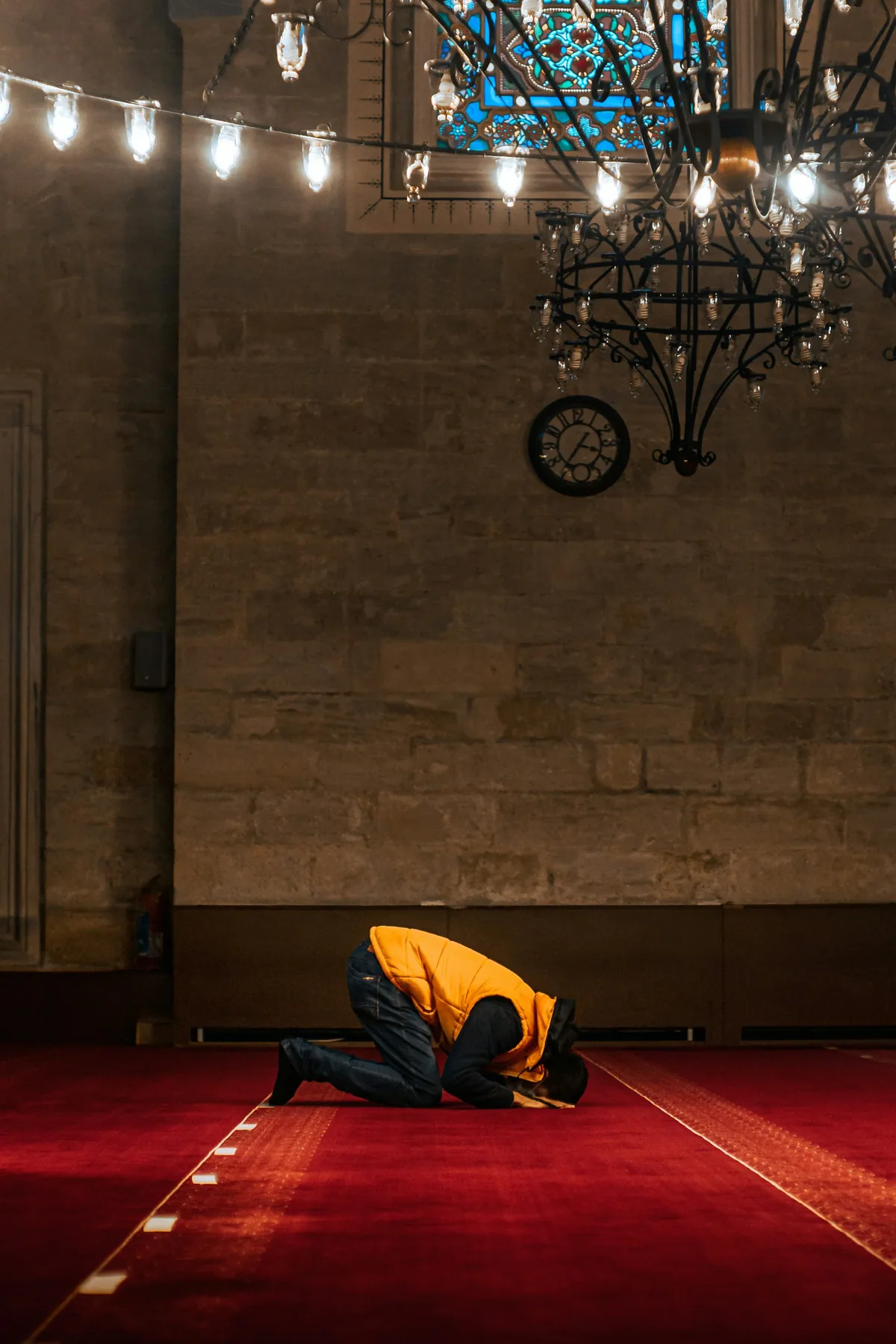
Salah, also written salat, is Islam’s structured ritual prayer. Muslims observe five daily prayer times, with recitation and bodily actions including standing, bowing and prostration. Prayer can be performed individually or with others. It is distinct from du‘a, personal supplication, although both belong to Muslim devotional life.[1]
A rhythm within an ordinary day
Prayer times relate to the day’s movement rather than one fixed clock schedule throughout the year. This helps explain why a local prayer timetable changes. A directory should link to a mosque’s current published schedule instead of hard-coding times that may quickly become wrong. The time window and a congregation’s announced start time also need not be identical.
The structure joins words, attention and movement. Describing the posture alone does not capture what worshippers understand themselves to be doing. Nor does a photograph reveal the content of a person’s private prayers, political beliefs or citizenship. A devotional scene is not a psychological profile.
Direction is not the object of worship
Muslims face the qibla, the direction of Mecca, for ritual prayer. Facing a shared direction does not mean worshipping a city or building. The distinction between the direction of worship and its object matters, particularly when unfamiliar ritual is interpreted through a hostile caption. Islamic belief directs worship to God.[1][2]
Preparation includes wudu in the relevant circumstances, a practice addressed in Qur’an 5:6. This connects ordinary washing facilities with worship without turning the facilities into a separate religious jurisdiction. The details of preparation and exemptions belong to qualified religious guidance rather than a photograph-based judgment about someone’s observance.[3]
Prayer at work, school or while traveling
A prayer space is a place to perform worship; it is not a court or an assertion of governmental control. A request for space or a scheduling accommodation should be assessed through the actual facts and applicable policy or law. It should not be treated as proof that nonparticipants will be compelled to pray.
At the same time, describing an activity as prayer does not resolve every question about access, safety, disruption or institutional responsibilities. A useful account identifies the request and the response rather than substituting a general argument about a foreign country’s religious policies.
Seeing the person rather than the spectacle
Visitors to a mosque should ask where they may sit, move and photograph. A person in prayer may not be able to participate in an interview at that moment. Giving worship its ordinary space is different from placing it beyond inquiry. Reporting can explain the practice without intruding on every participant.
Some people pray regularly, some inconsistently, and others identify as Muslim without observing the full pattern. Outsiders should not use a snapshot to adjudicate sincerity. Religious practice can be central without being perfectly uniform.
Salah is best understood as a repeated act of worship embedded in daily life. That simple fact explains much more about prayer rooms, schedules and mosque gatherings than the suggestion that an unfamiliar posture must conceal a political program.