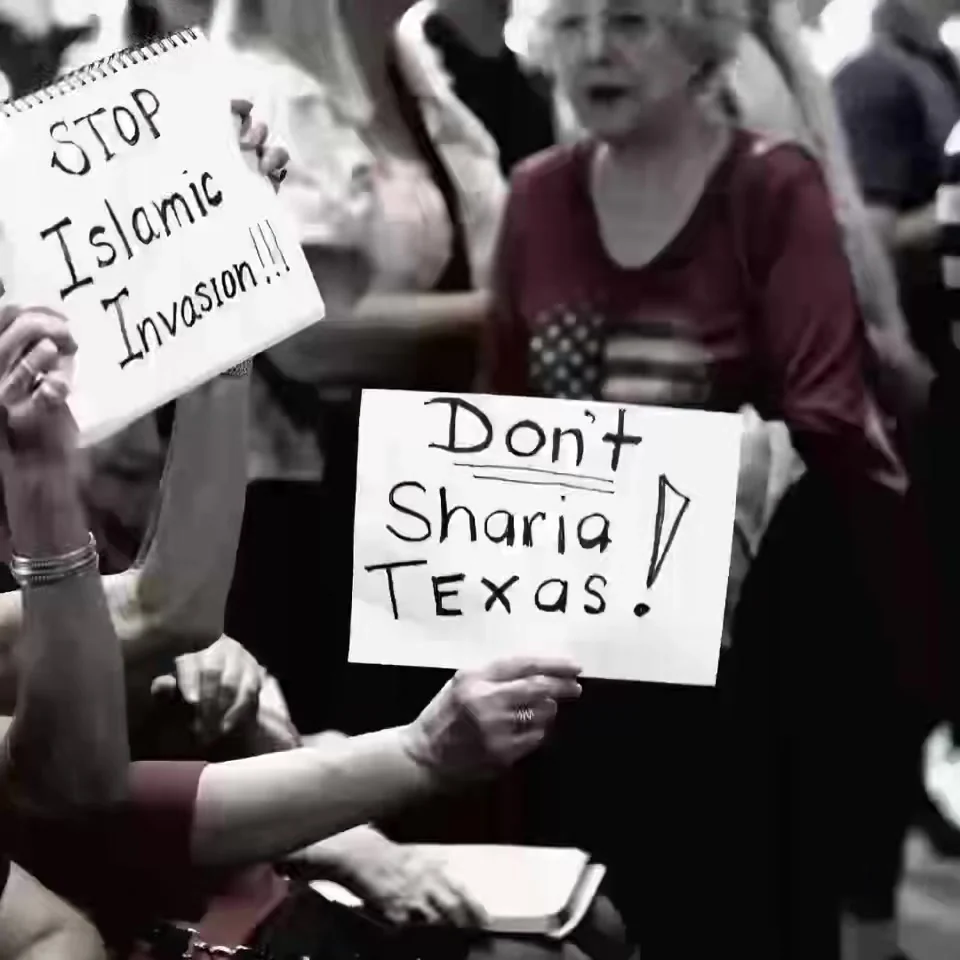
Texas politicians sold a Muslim takeover that the arithmetic cannot support. Some have now lost. Muslim Texans are still living with the suspicion they encouraged—and the agenda built around it.
Texas has a procedure for counting ballots. It has no corresponding department for collecting the suspicion left lying around afterward.
On November 3, Greg Abbott lost the governor’s race to Gina Hinojosa. Ken Paxton lost his Senate bid to James Talarico. Bo French lost his race for the Texas Railroad Commission to Jon Rosenthal. The voters have settled those contests. [1]
They have not settled what happens to the people these politicians made into campaign material. Muslim Texans still live in the neighborhoods where the accusations circulated. Our children still attend the schools. The mosques are still there. A campaign can close its office and reconsider its strategy. Muslim Texans have to carry on living among people who were repeatedly told to regard them as a threat.
The result also cannot tell us why each person voted as they did. Someone can reject a candidate’s competence while continuing to believe his account of an alleged enemy. Defeat removes an electoral opportunity. It does not automatically retract the story told to pursue it.
That is the unfinished business of this election. Politicians who helped normalize suspicion of Muslim Texans have suffered consequential losses. The organizations, policy ambitions, and public assumptions surrounding their campaigns deserve scrutiny that continues after the victory parties.
The neighbors became the issue
The targeting was explicit enough that we need not excavate its hidden meaning.
At CPAC in Grapevine in March, French said “the problem is actually Islam” and argued that Muslims could gain control of the United States by conquering Texas. He also urged Republicans to embrace Islamophobia more openly. The religion itself had become an electoral issue. [2]
Elsewhere, even ordinary courtesy supplied material for attack. Wesley Hunt’s Senate campaign used footage of John Cornyn wishing Muslims well during Ramadan in an advertisement called “Sharia John.” Cornyn’s campaign, meanwhile, attacked Paxton over the East Plano Islamic Center development, describing the proposed community as a “safe haven for Sharia law.” [3]
Consider the civic standard being established. A Ramadan greeting could be presented as a compromising act. A housing proposal could be narrated as a threat to the state. Under those conditions, Muslim visibility becomes suspicious before anyone examines what a particular person or institution has actually done.
Paxton’s campaign took that logic into an advertisement airing in May, attacking Cornyn over supposed support for “Muslim mass immigration.” FactCheck.org traced the quoted remarks to Cornyn discussing help for Afghan evacuees, including interpreters who had worked with American forces. The ad converted a statement about obligations to allies into an accusation about Muslims entering the country. [4]
There is a serious debate to be had about refugee policy, security screening, land use, and housing contracts. It requires people to identify a rule, an alleged violation, and the evidence. Replacing that work with a religious label makes the accusation much easier to circulate. Every Muslim can then be recruited into the story, whether or not they have any connection to the actual dispute.
All Hat, No Caliphate
The takeover narrative has an awkward relationship with arithmetic.
Pew Research Center’s September 2026 estimate puts the American Muslim population at approximately 5.5 million people of all ages. Against the Census Bureau’s population clock, showing roughly 343 million Americans at the time of writing, that works out to about 1.6% of the country, a calculation using the two estimates. [5] [6]
Put another way, in a representative group of 1,000 Americans, roughly 16 would be Muslim. That is an extraordinary number of people to assign responsibility for the impending collapse of the republic.
For Texas, Pew’s 2023–24 Religious Landscape Study estimates that about 2% of adults identify as Muslim. That state survey measures adults, so it should not be treated as an interchangeable version of the national all-ages estimate. Both figures describe a small minority. [7]
A small population can exercise political influence. Muslim Americans can organize, win elections, support causes, and persuade people who do not share their faith. That is ordinary democratic activity. Claims about particular organizations or policies can be examined on their evidence; a religious population count does not establish a coordinated project to govern everyone else.
The “takeover” story performs a more convenient trick. It treats participation itself as proof of sinister intent. A Muslim running for office becomes an infiltration story. A community becoming visible becomes a warning. Whatever we do supplies another installment of the accusation.
There is no demographic case in these figures for an approaching Muslim majority. And our rights would not expire if our numbers were larger. Religious freedom cannot be a permit that gets revoked when too many people apply.
Texas can accommodate another mosque without being conquered. It can survive a Muslim winning an argument. We ought to have a slightly more robust understanding of our state than the one offered by politicians who apparently believe its survival depends on everyone remaining nervous about the neighbors.
Now show us the invoice
The financial record deserves the precision the fear campaign lacked.
American pro-Israel political organizations appear in the funding histories of candidates who used these messages. Their support can be documented through named entities and dated disclosures, which give the public something concrete to examine.
In July 2026, the San Antonio Express-News, citing Federal Election Commission records, reported that AIPAC’s campaign arm had directed more than $1 million to John Cornyn between January 2025 and May 2026. [9]
Cornyn’s own July 2025 filing illustrates the funding channel: a $39,000 receipt dated April 16, 2025, labeled “AIPAC EARMARKED,” with individual donor attribution. That entry records donations routed through the PAC, rather than a single contribution from its treasury. It is one reported receipt within that fundraising period. [8]
There is also a direct disclosure involving Paxton. The Republican Jewish Coalition’s federal lobbying contribution report lists a $5,000 contribution from its PAC to Ken Paxton for Senate on June 1, 2026. The disclosed contribution followed the May advertisement about Muslim immigration. It records support for a candidate whose campaign had already used that message. [10] [4]
The organizations describe their political objectives openly. AIPAC PAC says its funding comes from American citizens seeking to strengthen the U.S.–Israel relationship. RJC describes the purpose of its contribution channel in terms of pro-America and pro-Israel principles. Their stated agendas, alongside their financial disclosures, establish the connection being examined. [11] [12]
The records establish support for candidates whose campaigns used the messages described here. They do not establish that either organization commissioned those particular advertisements, or that the Israeli government financed them. Contributions, donations routed through a committee, and independent advertising purchases are different transactions. Each deserves its own accounting.
The question that remains is substantial: what responsibility do political organizations accept for the conduct of the candidates they help finance? Which statements prompt reconsideration, and which are accepted as a tolerable cost of securing agreement on another issue?
A contribution does not establish agreement with everything a politician says. It does establish a political choice worth questioning. Organizations are entitled to explain that choice. Muslim Texans are entitled to examine the explanation, including whether hostility toward our community was considered serious enough to affect it.
The uncomfortable possibility is that a donor can regard a candidate’s position on Israel as essential while treating his treatment of Muslim Americans as negotiable. That is a question these records warrant asking. It should be answered with the same specificity as the donations.
The agenda already has next year’s date on it
We do not have to guess whether the anti-Muslim campaign was intended to survive November. The Republican Party of Texas has published 2026–2028 legislative priorities.
Under “Don’t Sharia Our Texas,” the party calls for treating Sharia advocacy or implementation as criminal sedition, disqualifying people from public, military, and law-enforcement service, and asking the federal government to denaturalize and deport Sharia advocates. These are party proposals, not a description of current law. Their stated timetable extends beyond this election. [13]
The document demonstrates why replacing individual officeholders is only part of the work. A proposal can remain available to the next candidate. A party can continue pressing it. The political permission to treat a religious community as a problem can survive changes in who has the authority to act on it.
The rhetoric had already reached state government. In September 2025, Abbott’s office promoted a ceremonial signing of House Bill 4211 as a ban on “Sharia compounds,” explicitly naming EPIC City. The bill, which had taken effect on June 20, regulates certain residential arrangements involving ownership interests in business entities, including contractual and discrimination rules. Abbott chose to sell those provisions to the public through the specter of a Muslim compound. [14] [15] [16]
That distinction matters. Officials can enforce housing standards and investigate evidence of wrongdoing. Portraying a religion as the underlying threat gives every subsequent dispute a ready-made interpretation. The public encounters the Muslim label first and may never reach the underlying facts.
Changing that requires work beyond electing different people. Existing policies need examination, proposed restrictions need sustained scrutiny, and officials need to explain what their accusations actually establish. A general election does not perform any of those tasks for us.
The suspicion is bigger than the population
The scale of the hostility is measurable.
In a Pew survey conducted May 4–17, 2026, 43% of U.S. adults said Muslims were less patriotic than other Americans, and 42% said Muslims had a negative impact on the country. These are national findings from before the election. They describe an environment of suspicion in which the campaigns operated, rather than a measured effect of any one politician’s advertising. [17]
A small religious minority thus confronts doubts about its belonging from a substantial portion of the public. That is a much larger problem than whether one candidate remains politically viable. The suspicion was available to these politicians, and they chose to give it further prominence.
The consequences can also reach far beyond an unpleasant argument. In May, Houston City Controller Chris Hollins publicly condemned threats against the Houston Ismaili Center. His statement concerned an actual place of worship in our city, with people who expected to be able to use it safely. [18]
Hollins’s statement does not connect those threats to a particular candidate. Their relevance is more immediate: a threat against a place of worship creates a problem for the people who use it, and counting ballots does not solve that problem. Campaign staff can move on to the next race. The congregation still has to think about safety.
Muslim communities are asked to absorb a peculiar cost of political competition: other people can debate whether portraying us as a danger was an effective strategy, while we have to consider what happens when someone takes the portrayal seriously.
The next round of political analysis should include that cost. Who has to spend time responding to accusations? Which institutions face scrutiny because of evidence, and which because their religious identity has made scrutiny politically rewarding? What would it take to correct a claim as publicly as it was circulated?
Those questions remain even when the original candidate has become yesterday’s news.
We live here
Muslim Texans should not have to respond by assembling a résumé impressive enough to earn an exemption from suspicion. Our entitlement to fair treatment does not depend on producing the right number of doctors, veterans, entrepreneurs, or grateful quotations.
We are allowed to be ordinary. We can argue about school funding, complain about traffic, practice our faith, neglect a committee meeting, and disagree with one another. We can be politically effective without being conspiratorial. We can criticize a government, including Israel’s, without surrendering our claim to belong in this one.
The responsibility belongs with the people who made the accusations. Politicians should correct misleading claims with the same visibility they gave the originals. Political organizations should answer questions about their financial support. Public officials should make clear which actions they are investigating and what evidence justifies it.
New officeholders have a responsibility of their own. A change in party control should produce fairer treatment in the decisions people actually encounter. Muslim Texans should be able to judge that record independently, without being assigned a permanent party allegiance in exchange for relief from hostility.
These defeats matter. They have closed off particular routes to power. What follows will depend on whether politicians correct their claims, whether their supporters demand better, and whether the next opportunist discovers that the same accusation still works. Muslim Texans should be able to recognize progress in something more durable than the result of a race: the ordinary assumption that our religion does not make us a problem the state has to solve.
We were Texans before we became somebody’s campaign material. We will still be Texans after the consultants have been paid.
Sources
- 1Texas Secretary of State — 2026 election results — Texas Secretary of State
- 2Bo French’s CPAC remarks on Islam — The Texas Tribune
- 3Anti-Muslim rhetoric in the 2026 Texas Republican campaigns — The Texas Tribune
- 4Fact check of Paxton’s immigration and Islam advertisement — FactCheck.org
- 5Growth of the U.S. Muslim community — Pew Research Center
- 6United States population clock — U.S. Census Bureau
- 7Religious Landscape Study: Texas — Pew Research Center
- 8Cornyn campaign FEC filing: April 16, 2025 AIPAC-earmarked receipt — Federal Election Commission
- 9AIPAC support in the Texas election — San Antonio Express-News
- 10Republican Jewish Coalition federal lobbying contribution disclosure — U.S. Lobbying Disclosure Act database
- 11AIPAC PAC: mission and contribution channel — AIPAC PAC
- 12RJC PAC: candidate contribution channel — Republican Jewish Coalition PAC
- 13Republican Party of Texas 2026–2028 legislative priorities — Republican Party of Texas
- 14Abbott’s September 2025 HB 4211 signing announcement — Office of the Texas Governor
- 15HB 4211 legislative actions and effective date — Texas Legislature Online
- 16HB 4211 enrolled bill text — Texas Legislature Online
- 17Americans’ views of U.S. Muslims, May 2026 survey — Pew Research Center
- 18Statement on threats against the Houston Ismaili Center — Houston City Controller
About the author
Omar Afra is a Houston-based publisher and the founder and editor of Texas Muslim. He publishes Testset and Live Index and founded Free Press Houston.