Opinion / Sourced analysis
Texas’s Fight Over Islam Hits the Ballot Box
Texas politicians have turned mosques, Muslim schools, housing developments and history lessons into political battlegrounds. November will help determine who wields power over education, state courts and the public programs where those fights become policy—with religious liberty, equal treatment and the limits of government power at stake far beyond the governor’s race.
By Omar Afra ·
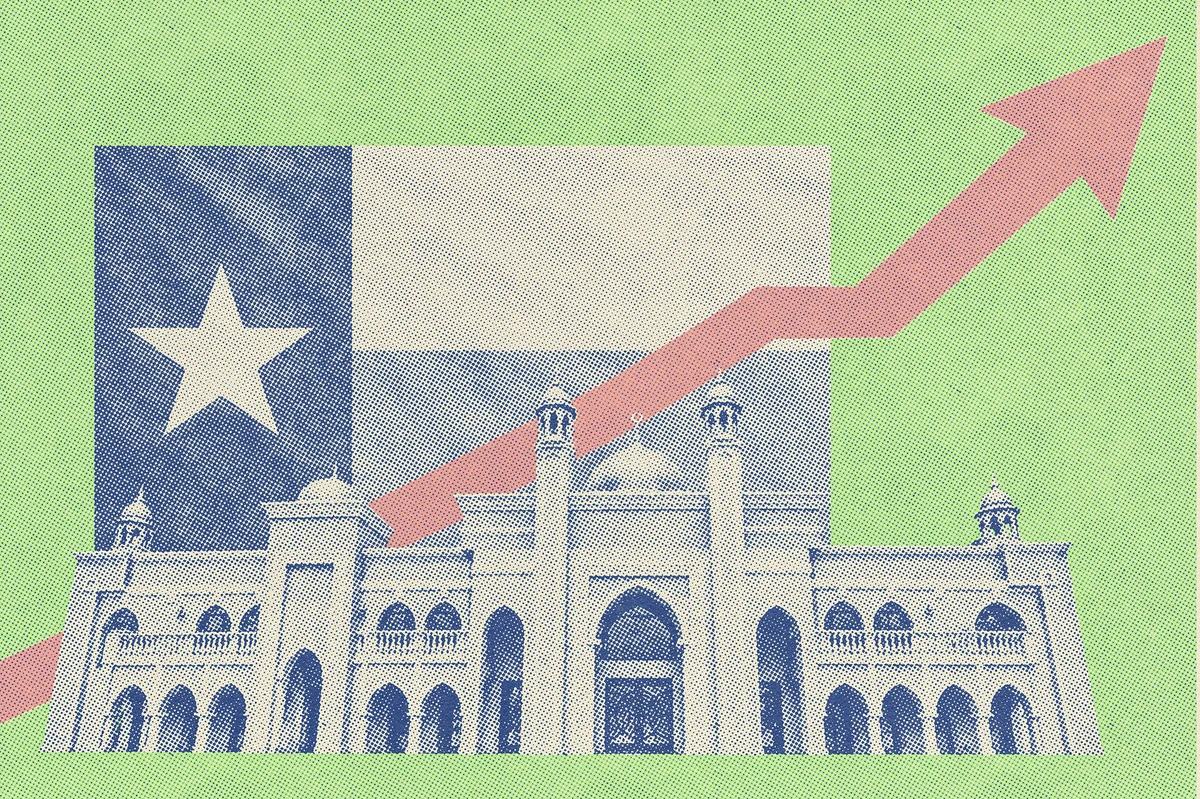
Texas politicians have spent a remarkable amount of time examining how Muslims pray, where they build, which schools their children attend and what everybody else’s children should learn about their religion. The attention comes with consequences: agency inquiries, application deadlines, curriculum votes and legal bills. The people signing the documents wield powers considerably more consequential than a campaign microphone.
That is where this election gets interesting. Texas Muslim’s 2026 voter guide covers 18 statewide races, while nine seats on the State Board of Education are also on November’s ballot. Together, those contests reach well beyond the familiar personalities at the top of the ticket. They concern who administers public programs, sets educational standards, brings lawsuits and exercises the authority to make ordinary life difficult. Religious freedom gets considerably less abstract when somebody else controls the application.
2020 Texas Estimate: 313,209 Muslim Adherents
Start with the numbers, because the panic has been doing a hell of a lot of work without them. Our population explainer identifies 313,209 Muslim adherents in the 2020 U.S. Religion Census’s Texas entry. A resolution introduced in the Texas Legislature in 2025 cited approximately 500,000 Muslims. Those figures use different sources and definitions; they cannot be stitched into a tidy growth chart or relabeled as registered voters.
The institutional picture is similarly concrete. Our mosque-count guide compares roughly 280–340 mosque and center listings, depending on the source and inclusion rules. Its September comparison found 282 listings in one directory and 332 in another. The distinction is mundane and necessary: directories count differently. A building inventory is a lousy substitute for evidence of a political conspiracy.
These are residents and institutions with ordinary needs: classrooms, burial arrangements, places to worship and somewhere to park. Texas Muslim’s Muslim Texas, Documented organizes that institutional evidence. The sensible questions concern what an organization does, which rules apply and whether government applies them consistently. Substituting a frightening religious label for those questions makes the argument easier and the government worse.
Nine Seats. More Than Five Million Students.
The State Board of Education approved revised high-school social studies standards on September 4 in an 8–4 vote over objections from Muslim advocates. The controversy included language describing the military campaigns of the Prophet Muhammad (PBUH) as “brutal.” Republican board member Will Hickman unsuccessfully sought to remove that adjective, questioning why other military campaigns were not described the same way. At least three board-appointed experts objected to the broader portrayal of Islam, The Texas Tribune reported October 22.
That is a dispute about historical judgment and consistency. Texas Muslim’s explainer on teaching about religion distinguishes academic study from devotional instruction. Schools can examine religion, warfare, slavery and political power seriously. The question is whether they apply comparable standards of evidence and description across the material. A tendentious adjective does not become scholarship because a board majority approves it.
The board has 15 elected members, and its decisions affect more than five million public-school students. Nine seats are up this November. Its official responsibilities include curriculum standards, instructional materials and graduation requirements. These are offices with the authority to shape what future textbooks contain. Their relative obscurity is no measure of their power.
The campaign-finance record deserves equal attention. Houston Public Media reported that Texans for Educational Freedom supplied more than $300,000 in services collectively to Republican candidates Victoria Hinojosa, Kason Huddleston and Tiffany Nelson, including mailers and text campaigns. Texans for a United Conservative Majority, which the report identifies as largely funded by Tim Dunn, contributed roughly $50,000 collectively to those same candidates. Nelson said her supporters shared her priorities and rejected the suggestion that their backing determined those priorities. The donations establish financial support; scrutiny of policy influence requires examining the candidates’ statements and conduct alongside it.
$10,474: The Standard Private-School Award for 2026–27
The voucher dispute shows how an administrative decision can place religious equality on a deadline. As documented in The Muslim Tax, Islamic schools and families went to federal court over access to the Texas Education Freedom Accounts program. On March 17, Judge Alfred H. Bennett ordered application access for the plaintiff schools and extended the family deadline to March 31.
The subsequent approvals matter. By March 31, the comptroller’s office said every eligible Islamic school that had applied was approved. Bennett denied a further emergency extension, leaving the constitutional merits unresolved in that order. That sequence, detailed in the Tribune’s account of the voucher proceedings, records litigation, access and continuing disagreement. An honest account includes all three.
The financial stakes were substantial. The state’s own program page lists $10,474 for an awarded private-school student in 2026–27. That is a program benefit, not a measured loss for every family involved in the dispute. It does explain why the decisions of the comptroller’s office belong in an election story about religious liberty. The person administering a public benefit can matter enormously before a judge ever hears a case.
Five State Actions Involving EPIC City: March 25–April 1, 2025
The same discipline applies to EPIC City, now called The Meadow. Our public-record timeline documents a consumer-protection demand, securities and fair-housing inquiries, a Texas Rangers investigation and an environmental-permit issue announced between March 25 and April 1, 2025. Multiple agencies brought multiple forms of scrutiny to the same development.
Each action requires examination on its own evidence. Developers remain accountable to laws governing housing, finance and the environment. Officials remain accountable for how they deploy the machinery of enforcement. Announcing an investigation does not establish a violation, and the political usefulness of an accusation does not improve its evidentiary value. A politician’s press release does not carry the force of a verdict.
Then there is the difference between legislative text and its sales pitch. Texas Muslim’s HB 4211 analysis compares the governor’s announcement about banning “Sharia compounds” with an enrolled bill regulating specified entity-owned residential arrangements. The bill addresses property arrangements and related protections; it does not enact a general prohibition on Muslim religious practice. Our guide to Sharia-related laws and claims also explains that private religious arbitration remains subject to applicable law and judicial review.
A politician making a claim about Sharia should be able to identify the conduct, the rule and the evidence. The word itself covers religious, ethical and jurisprudential traditions. Treating all of that as a single hostile institution is useful campaign shorthand and lousy public analysis. Chest-thumping about a parallel government is a poor substitute for identifying an actual violation.
North Texas Votes: 88 Registrations in 2025; 700+ by October 2, 2026
There are signs that these disputes are attracting civic attention. On October 2, NBC DFW reported that North Texas Votes had registered more than 700 people at area mosques in 2026, compared with 88 in 2025. Cofounder Bonnie Moore said the nonpartisan group was operating in 21 mosques that day. The figures describe one organization’s work across different election years.
In Houston, Islamic Society of Greater Houston President Emran Gazi said September 16 that the organization was helping register about 1,000 voters a week at mosques. The Houston Chronicle reported his remarks at a gathering opposing the school standards. These are organizers’ reports of registration activity, with no independently established statewide total.
National research provides a longer perspective. ISPU’s American Muslim Poll 2025 puts registration among eligible Muslim Americans at 85%, compared with 60% in 2016. That is a national registration measure. Texas Muslim’s earlier analysis of the community’s potential electoral significance explains the limits of translating population, geography and participation into an election prediction. No honest arithmetic turns a mosque directory into a guaranteed voting bloc.
Muslim Texans disagree about economics, education, foreign policy and candidates. Increased registration cannot settle those disagreements or establish a party’s entitlement to anyone’s support. It can make the question of government conduct harder to keep confined to speeches and press conferences.
18 Statewide Races in Texas Muslim’s 2026 Voter Guide
The powers on this ballot are distinct. The governor’s office signs or vetoes legislation and makes consequential appointments. The attorney general represents the state and exercises civil-enforcement powers. The comptroller administers the voucher program. Elected education-board members set academic standards. Federal judges, including the judge who intervened in the voucher dispute, operate through a separate appointment system.
That is why the public record matters more than campaign branding. Greg Abbott’s record includes his state proclamation designating CAIR a foreign terrorist and transnational criminal organization; the record distinguishes that state action from a federal designation. Ken Paxton’s record documents his actions as attorney general, while his current candidacy is for the U.S. Senate, an office with different powers. A serious account follows the authority as carefully as the name.
The underlying standard is already written into Texas law. Article I, Section 6 of the Texas Constitution rejects legal preference for a religious society or form of worship and directs equal protection of peaceful public worship. Our religious-freedom guide traces the additional state and federal protections. Those protections require careful application to the facts; they also give officials something considerably more demanding to satisfy than their own campaign slogans.
Texas has no need to invent a religious qualification for belonging. Muslim identity does not disqualify a person from public office, and religion does not confer or remove voting eligibility. The promise of equal citizenship survives a politician finding it inconvenient. The question running through November’s ballot is how the people entrusted with public power will honor that promise when the campaign ends.
Sources
- 12026 voter guide
- 2population explainer
- 3mosque-count guide
- 4Muslim Texas, Documented
- 5The Texas Tribune reported October 22
- 6explainer on teaching about religion
- 7official responsibilities
- 8Houston Public Media reported
- 9The Muslim Tax
- 10the Tribune’s account of the voucher proceedings
- 11state’s own program page
- 12comptroller’s office
- 13public-record timeline
- 14HB 4211 analysis
- 15guide to Sharia-related laws and claims
- 16religious, ethical and jurisprudential traditions
- 17NBC DFW reported
- 18Houston Chronicle reported his remarks
- 19American Muslim Poll 2025
- 20analysis of the community’s potential electoral significance
- 21governor’s office
- 22attorney general
- 23Greg Abbott’s record
- 24Ken Paxton’s record
- 25U.S. Senate
- 26Article I, Section 6 of the Texas Constitution
- 27religious-freedom guide
- 28Muslim identity does not disqualify a person from public office
- 29religion does not confer or remove voting eligibility