Research
Latino Muslims in Texas: IslamInSpanish and the Work of Translation
A Houston institution’s publishing history connects language, family and community space without turning one organization into a census.
Research: Texas Muslim · Founder and editor: Omar Afra

Translation is often described as a matter of vocabulary. In a religious community, it can also determine who gets to ask a question, understand an explanation or take part in a family conversation. IslamInSpanish’s account of its beginnings makes that practical problem central: its founder, Mujahid Fletcher, describes wanting to discuss Islam with his Spanish-speaking family after his own conversion.
That is a particular person’s and institution’s history, not a template for every Latino Muslim. It offers a way into the subject that is more useful than treating Latino and Muslim as competing identities. One describes a broad ethnic and cultural identification; the other a religious one. Neither tells a reader everything about someone’s language, citizenship, family or route into faith.
From a publishing project to a community space
The organization’s founding account emphasizes educational recordings and media made for Spanish-speaking audiences. Its Houston history dates an earlier Centro Islamico opening to January 30, 2016. Later, Houston Chronicle reporting in November 2024 documented the opening of the newer center in Alief. Those are separate milestones, not two dates to be collapsed into one opening claim.
The distinction is useful because a community’s media, programs and premises can grow at different speeds. A building does not exhaust the work of an organization that also publishes educational material, and an online audience is not the same as the number of people who attend a local center. Our institutional timeline records events without pretending they are interchangeable population measures.
What the research can support
The Institute for Social Policy and Understanding’s 2023 report, developed with IslamInSpanish, used qualitative research to examine Latino views of Muslims and Islam. The published methods describe nine individual interviews and nine focus groups conducted between December 2022 and May 2023. Those conversations can illuminate experiences and recurring themes; they cannot establish how many Latino Muslims live in Texas.
This limitation is not a reason to discard the research. It is a reason to ask the right question of it. A qualitative account is valuable for understanding language, perceptions and interaction. A statewide numerical claim needs a population measure designed for that purpose. Linking the original report allows a reader to examine the participants, methods and findings rather than inheriting an unsupported number.
A Houston story without an exotic exception
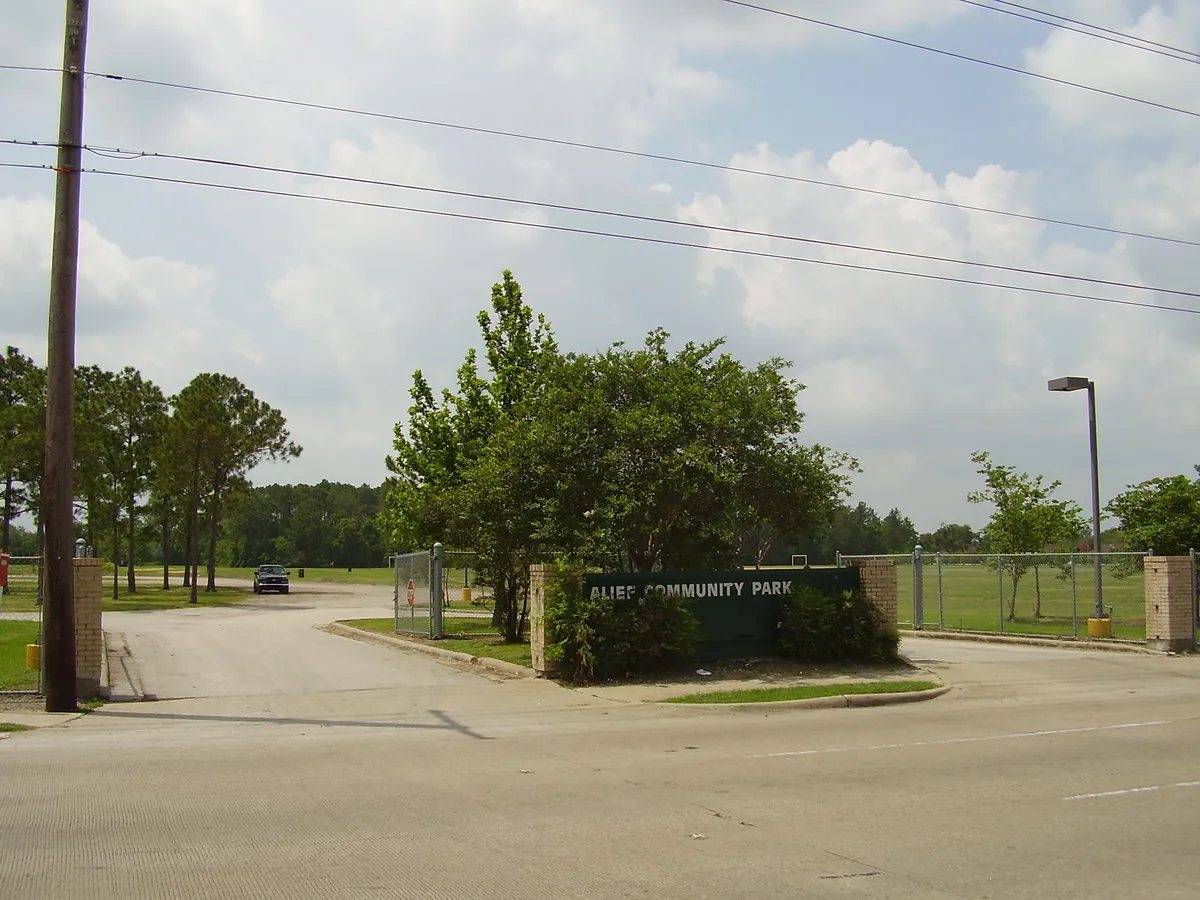
The Houston Atlas places IslamInSpanish in a larger landscape of institutions and community services. The contextual photograph here is an archival image of Alief Community Park, not the Centro Islamico. Its function is to locate the story in a Houston neighborhood; the opening dates and institutional claims come from the sources, not from an unrelated building photograph.
Readers who want practical starting points can also use the new-Muslim guide. A source-based history need not turn every life into a dramatic conversion narrative. Sometimes the significant work is ordinary and durable: making an explanation understandable, giving a question somewhere to go, and building an institution around the languages people already use.
Sources
- 1The Story of IslamInSpanish — IslamInSpanish · retrieved 2026-10-04
- 2Houston: IslamInSpanish Centro Islamico — IslamInSpanish · retrieved 2026-10-04
- 3Latino-led Islamic center opening in Alief, November 2024 — Houston Chronicle · retrieved 2026-10-04
- 4Latino Attitudes Toward American Muslims and Islam — Institute for Social Policy and Understanding · retrieved 2026-10-04
- 5National Latino Study — IslamInSpanish / ISPU · retrieved 2026-10-04