Atlas · guide
Muslim Houston: history, institutions and practical resources
A regional guide to mosques, schools, campus life, Spanish-language programs, cultural visits and burial services across Greater Houston.
Edited by Omar Afra · Published · Updated
Sources checked 2026-09-22. Reference years are shown with historical figures.
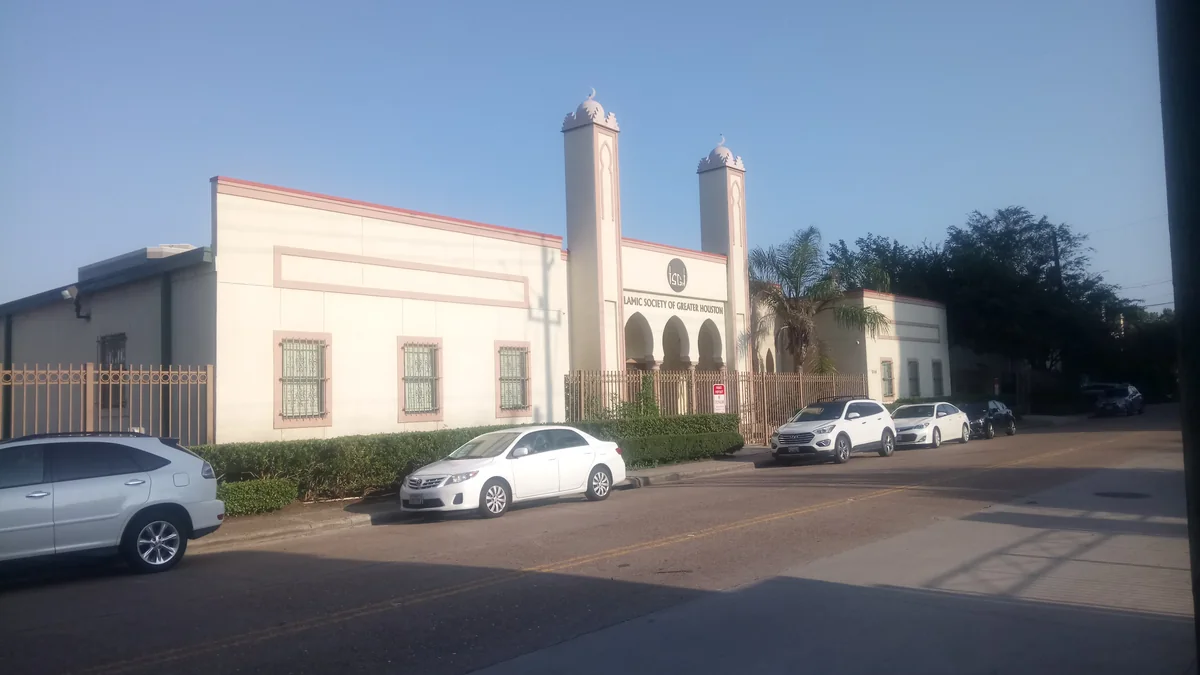
Muslim Houston is best understood through its institutions and the connections between them, not as a single neighborhood or a headline population estimate. A university organization, a suburban prayer space, a Spanish-language educational center and a downtown mosque can all belong to the same regional story while serving different purposes. This guide connects those places to the source pages a reader needs to use them.
“Houston” here means a practical regional guide, not a statistical claim about the city boundary. Locations in Spring, Katy, Stafford, Sugar Land, Webster and Waller remain identified by their actual municipality or postal location. The statewide population discussion belongs in the Almanac; the purpose here is to make the region legible through documented institutions.
Start with the service you need
| Need | Useful starting point | Why this route helps |
|---|---|---|
| A mosque or community center | ISGH centers directory and Texas Muslim mosque records | Identifies individual locations rather than treating one organization as all of Houston. [1] |
| Full-time school information | Houston school examples below and schools registry | Separates campus location from the operator’s network. |
| Spanish-language introductory programs | IslamInSpanish | A dedicated Spanish-language community and educational resource. [2] |
| A public cultural visit | Ismaili Center visitor guide | Describes tours, access and visitor arrangements. [3] |
| University Muslim life | UH resource and Rice resource | Uses campus-specific organizations and prayer information. |
| Funeral or burial arrangements | ISGH funeral services and funeral guide | Distinguishes funeral-home coordination from the cemetery location. [4] |
The institution’s own page is the next step, not merely a citation at the bottom. A family asking about school enrollment and a visitor asking about a Friday service need different contacts even when the programs share a property. Opening times, eligibility and appointments should come from the operator handling the particular service.
How the institutional landscape developed
The Islamic Society of Greater Houston dates its establishment to 1969, describing early organizing by University of Houston students and professionals and prayer gatherings in private homes. That history places student networks and volunteer organization before the large facilities visible today. ISGH is a major institutional network, but its history is not a substitute for the histories of Houston’s other Muslim communities. [5]
Black Muslim institutional life is represented by congregations including Masjid Warithuddeen Mohammed, whose own history and mission identify a longstanding Houston community. IslamInSpanish supplies another important strand through Latino-led educational work and Spanish-language programs. These institutions make a city guide more accurate than an account organized exclusively around immigration from the Middle East or South Asia. [6][2]
Houston’s Islamic Education Center identifies an Ithna Ashri Shi‘a institutional tradition and connects worship with educational and community services. Ismaili Center Houston, inaugurated in November 2025, is a different institution with a different religious and civic role. Sunni, Twelver Shi‘a and Ismaili organizations should not be flattened into a single administrative system. The city’s Muslim life is a network of distinct communities, not branches of one headquarters. [7][8]
| Date | Milestone | What the date describes |
|---|---|---|
| 1969 | ISGH established | Formation of an organization, not the beginning of every Muslim community in Houston. [5] |
| 1987 | Rice MSA’s stated beginning | A campus organization’s history. [9] |
| 1994 | Hakeem Olajuwon acquired the downtown property later used by the Islamic Da’wah Center | A property acquisition. [10] |
| 2002 | Islamic Da’wah Center opened | The opening of the renovated downtown institution. [10] |
| December 2020 | ISGH Muslim Cemetery’s stated establishment | A burial facility in Waller serving the wider region. [11] |
| November 2025 | Ismaili Center Houston inaugurated | A new building and civic institution, not the start of Ismaili life in Texas. [8] |
Reading the regional geography
ISGH’s centers page provides a useful starting geography: Masjid Bilal on Adel Road and Masjid Al Salam in Spring; Masjid Aqsa in Katy; Al Sabireen on Brand Lane in Stafford; Maryam Islamic Center and Masjid At Taqwa in Sugar Land; and Abu Bakr on Galveston Road. These named locations illustrate the spread of facilities across the region. The directory also explicitly marks its Spring Branch location as having no Jummah, a practical detail a generic map can miss. [1]
Use this as an institutional orientation, not a map of where individual Muslims live. A center’s attendees may come from several places, and a person’s school, workplace and congregation may be in different municipalities. The route that matters for a visit is the actual address and entrance, not whether a listing has been grouped under a broad “Houston” heading.
Outside ISGH, IEC’s current main-site contact identifies 2313 South Voss Road, while other organizations publish their own locations and programs. Avoid assuming that an organization’s school, headquarters and worship facility always share an address. Where a website lists more than one site, establish which site hosts the service you intend to use. [12]
Schools and learning
The school landscape includes full-time education, weekend instruction, Qur’an study and adult programs. These should be compared within the appropriate category. A weekly class is not a substitute for a full-time school listing, and a school’s affiliation with a mosque does not establish its current grade range, admissions policy or independent accreditation.
The ISGH school directory names Darul Arqam Academy North on Adel Road, Houston Peace Academy in Spring, ILM Academy on Conrad Sauer Drive, and Everest Academy in Stafford. Their addresses show why the useful unit for a parent is a campus rather than the entire metropolitan area. Texas Muslim’s records link onward to the published school information rather than rating educational quality. [13]
Use the individual records for Darul Arqam North, ILM Academy, Everest Academy and Houston Peace Academy as starting points. Before arranging a visit, ask the school for the current academic-year grade range, admissions availability, tuition and financial-aid information, instructional model, transport options and any accessibility support needed. These are questions for the school, not characteristics inferred from its religious identity.
Universities and student communities
The University of Houston’s A.D. Bruce Religion Center lists Muslim-affiliated organizations among its campus groups. That university source is a better starting point for student access than a general community directory. Rice MSA publishes its own history and prayer arrangements, making it possible to distinguish a campus meeting or prayer room from a publicly accessible neighborhood mosque. [14][9][15]
Students should check the current university calendar and organization contact before relying on a room number or a weekly schedule copied elsewhere. Semester breaks, exams and building access can affect arrangements. The Campus Index keeps the university as the organizing unit; this regional page supplies the connection to the surrounding city.
A cultural visit beyond a map pin
The Islamic Da’wah Center occupies a renovated historic downtown bank building. Its history connects the property acquired by Olajuwon in 1994 with the center’s opening in 2002; its visitor information describes the educational setting. It offers a concrete way to explore the relationship between Houston’s built environment and Muslim institutional life without treating religious architecture as something detached from the city around it. [10][16]
Ismaili Center Houston offers public visitor information and guided tours through its own booking system. The guide describes free admission and distinctions between publicly accessible areas and the prayer hall. Use that page for current booking, parking and photography arrangements rather than assuming that access to a garden means unrestricted access throughout a worship building. [3]
For a school or workplace group, make the purpose clear when arranging a visit: architectural interest, introductory religious education or observation of a service. Ask permission before photographing people. A visit can be both welcoming and well organized without requiring a congregation to function as an unscheduled museum tour.
Funeral services and burial geography
ISGH publishes information for Hamza Funeral Home and Bilal Funeral Home, while its Muslim cemetery is at 22505 Stokes Road in Waller. The cemetery’s own site describes a 58-acre property. The important practical point is that funeral preparation, a prayer gathering and burial need not happen at the same address. [4][11]
Start with the provider coordinating the arrangements and ask which locations and contacts apply to each step. The funeral guide and cemetery index separate providers from burial sites. This Atlas does not guarantee capacity, quote a current price or prescribe a family’s religious arrangements; it directs readers to the organization responsible for those decisions.
What local research contributes
New America’s Houston Muslim Study surveyed 773 respondents from March 30 to May 2, 2021. In that sample, 54 percent lived in Harris County, 27 percent in Fort Bend and 12 percent in Brazoria; 86 percent reported a college degree or higher. The report explicitly notes that the sample was skewed toward men. Those are respondent characteristics, not a complete demographic profile of all Houston Muslims. [17]
Rice’s Boniuk Institute offers another useful perspective: its discussion of regional religious change distinguishes congregation growth from estimates of individual adherents and cautions that Muslim population estimates are difficult. Together these sources support a more careful regional portrait than an undated assertion that a particular neighborhood or city contains a precise number of Muslims. [18]
The strongest use of this guide is practical and historical: locate a named institution, understand its role, follow its current source and connect it to the region’s longer story. For numerical claims, use the Almanac’s source comparison. For a meal rather than a research project, the separate halal barbecue directory identifies businesses and the halal statements they actually publish.
Sources
- 1ISGH Islamic centers and addresses — Islamic Society of Greater Houston · checked 2026-09-22
- 2IslamInSpanish: programs and community information — IslamInSpanish · checked 2026-09-22
- 3Plan your visit to Ismaili Center Houston — Ismaili Center Houston · checked 2026-09-22
- 4ISGH funeral services and funeral-home locations — ISGH Muslim Cemetery · checked 2026-09-22
- 5About the Islamic Society of Greater Houston — Islamic Society of Greater Houston · checked 2026-09-22
- 6About Masjid Warithuddeen Mohammed — Masjid Warithuddeen Mohammed · checked 2026-09-22
- 7Islamic Education Center of Houston: organization and services — Islamic Education Center of Houston · checked 2026-09-22
- 8Ismaili Center Houston inauguration, November 6, 2025 — Aga Khan Development Network · checked 2026-09-22
- 9Rice Muslim Students Association — Rice Muslim Students Association · checked 2026-09-22
- 10History of the Islamic Da’wah Center — Islamic Da’wah Center · checked 2026-09-22
- 11ISGH Muslim Cemetery: location and services — ISGH Muslim Cemetery · checked 2026-09-22
- 12IEC Houston contact and program links — Islamic Education Center of Houston · checked 2026-09-22
- 13ISGH school directory — Islamic Society of Greater Houston · checked 2026-09-22
- 14A.D. Bruce Religion Center: affiliated organizations — University of Houston · checked 2026-09-22
- 15Rice MSA prayer locations and arrangements — Rice Muslim Students Association · checked 2026-09-22
- 16Islamic Da’wah Center visitor information — Islamic Da’wah Center · checked 2026-09-22
- 17Houston Muslim Study, published May 20, 2022; fieldwork March–May 2021 — New America / Robert L. McKenzie · checked 2026-09-22
- 18Religious Change in the Houston Area, December 11, 2025 — Boniuk Institute, Rice University · checked 2026-09-22