Texas has a large, old and varied Muslim community, and no single number that captures it. Here is what each familiar figure actually measures, where the congregations are, and why a mosque count is a story about institutions rather than a census.
The number everyone wants
Every few months a headline needs a figure. How many Muslims live in Texas? How many mosques? The questions are fair. The trouble starts when a number arrives without its year, its unit or the people who produced it, and is then repeated until it sounds like a fact of nature.
Texas does not count its residents by religion, and the decennial U.S. census does not ask about it. Every figure in circulation comes from somewhere else: a survey, an encyclopedia estimate, a count of congregations or a sentence in a legislative resolution. Each is useful. None is the same as the others, and lining them up as if they were one series implies a trend those sources cannot establish. [18]
So this piece does something less dramatic and more useful. It puts each number next to what it measures.
A community the size of a big city
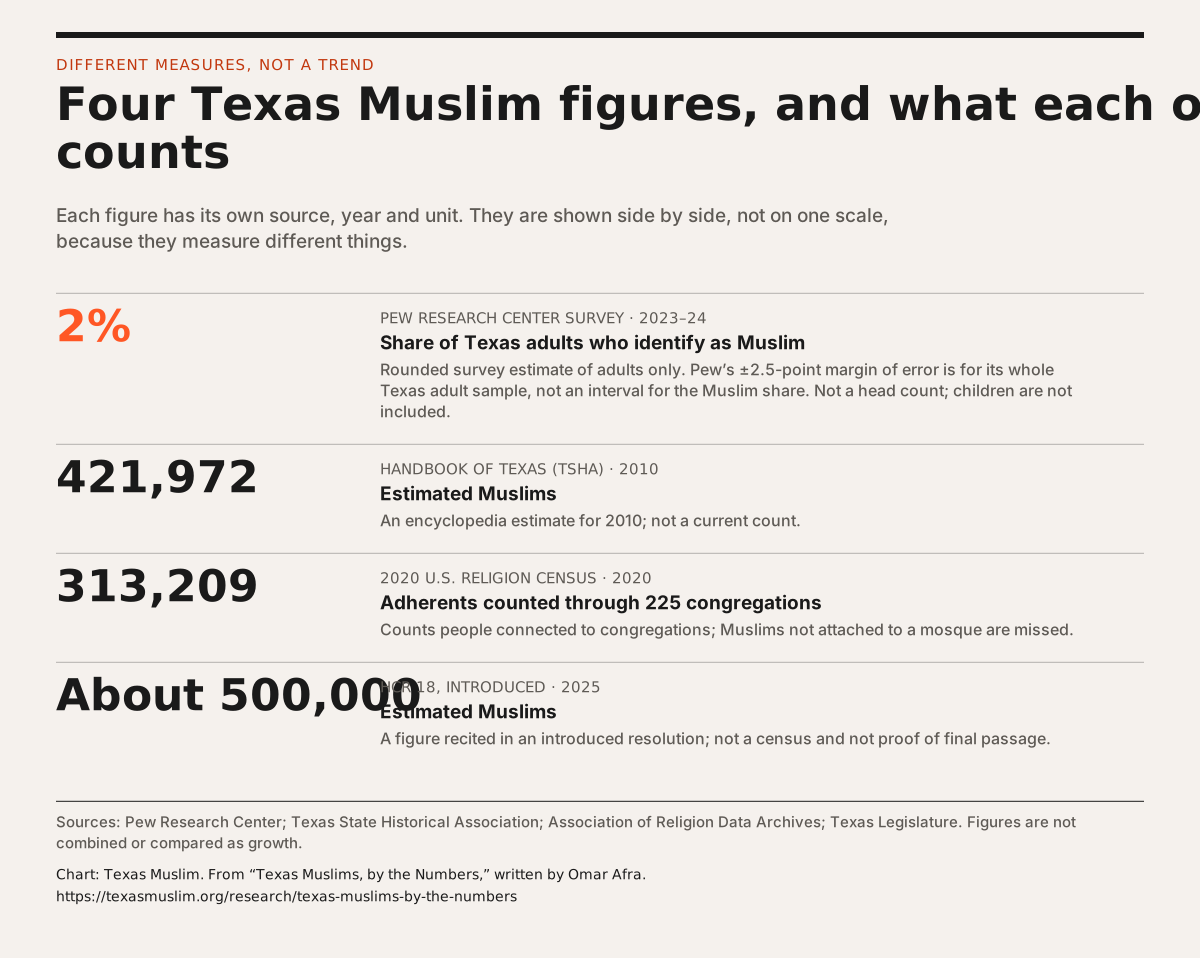
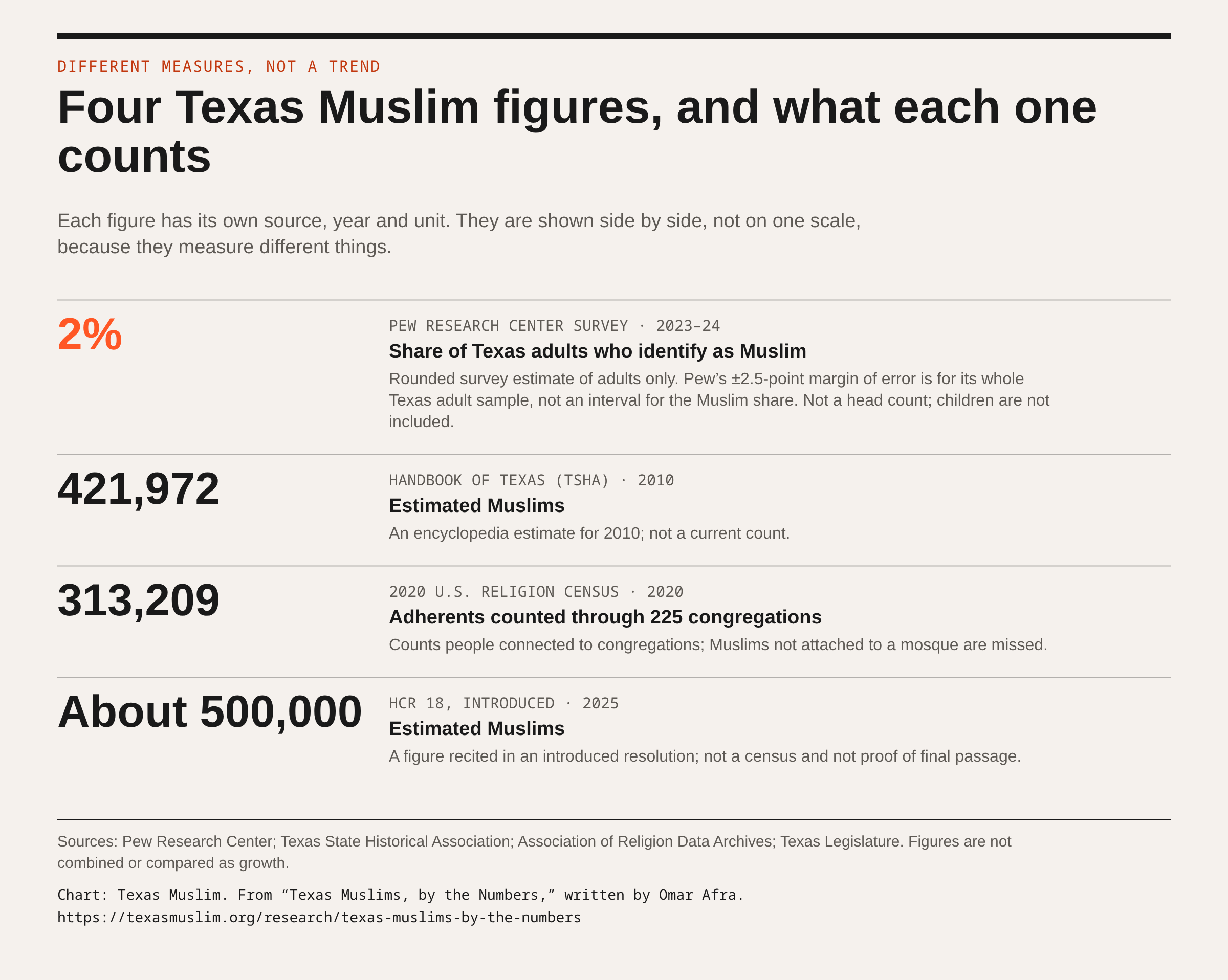
The newest broad measure is a survey. In Pew Research Center’s 2023–24 Religious Landscape Study, about 2% of Texas adults identified as Muslim. That is a rounded share of adults who answered a survey. Pew’s published margin of error, ±2.5 percentage points, applies to its whole sample of Texas adults; it is not a range around the Muslim share. The figure does not count children, and it was not designed to be multiplied into a precise head count. [1]
Older measures put the community in the hundreds of thousands. The Texas State Historical Association’s Handbook of Texas gives an estimate of 421,972 Muslims for 2010. The 2020 U.S. Religion Census counted 313,209 adherents connected to 225 congregations in Texas, a method that by design misses people who are not attached to a mosque. A resolution introduced in the Texas House in 2025 recites an estimated 500,000. [2][3][4]
The 2020 figure is lower than the 2010 one. That is not evidence that Muslims left Texas; the two sources count different things in different ways. Nor does the 500,000 in a 2025 resolution prove that the community grew after 2020. A resolution’s opening clauses record what its sponsors chose to recite, and an introduced resolution is not proof that it passed.
Whichever measure you prefer, the scale is roughly that of a large Texas city. That is enough people to sustain hundreds of congregations, full-time schools, clinics and cemeteries, and it is a community of many kinds of Texans: longstanding Black Muslim congregations and recent arrivals, university students and their grandparents, Sunni, Shia and Ismaili institutions that each keep their own calendars.
Four sources, four measures
Texas Muslim population figures, each with its own unit — not a trend
| Source and year | Figure | What it measures |
|---|---|---|
| Pew Research Center survey2023–24 | 2%of adults | Share of Texas adults who identify as Muslim. Rounded survey estimate of adults only. Pew’s ±2.5-point margin of error is for its whole Texas adult sample, not an interval for the Muslim share. Not a head count; children are not included. Pew Research Center |
| Handbook of Texas (TSHA)2010 | 421,972 | Estimated Muslims. An encyclopedia estimate for 2010; not a current count. Texas State Historical Association |
| 2020 U.S. Religion Census2020 | 313,209 | Adherents counted through 225 congregations. Counts people connected to congregations; Muslims not attached to a mosque are missed. Association of Religion Data Archives |
| HCR 18, introduced2025 | About 500,000 | Estimated Muslims. A figure recited in an introduced resolution; not a census and not proof of final passage. Texas Legislature |
The rows are listed by source, not joined by a line or drawn on one scale: an encyclopedia estimate, a congregational count and a legislative recital measure different things, so a lower 2020 figure is not evidence of decline and a 2025 recital is not a new measurement. Pew’s survey share is a percentage of adults, drawn as 2 squares in 100 because the published figure is rounded to a whole percent.
Sources: 2023–24 Religious Landscape Study: adults in Texas (Pew Research Center, checked November 9, 2026) · Muslims, Handbook of Texas (Texas State Historical Association, checked November 9, 2026) · 2020 U.S. Religion Census, Texas state membership report (Association of Religion Data Archives, checked November 9, 2026) · HCR 18, introduced text, 89th Legislature, 2025 (Texas Legislature, checked November 9, 2026)
Download this chart
Chart: Texas Muslim. From “Texas Muslims, by the Numbers,” written by Omar Afra. Please credit Texas Muslim and link to the article. Data: Pew Research Center; Texas State Historical Association; 2020 U.S. Religion Census (ASARB); Texas Legislature. Each producer’s terms apply.
Where the congregations are
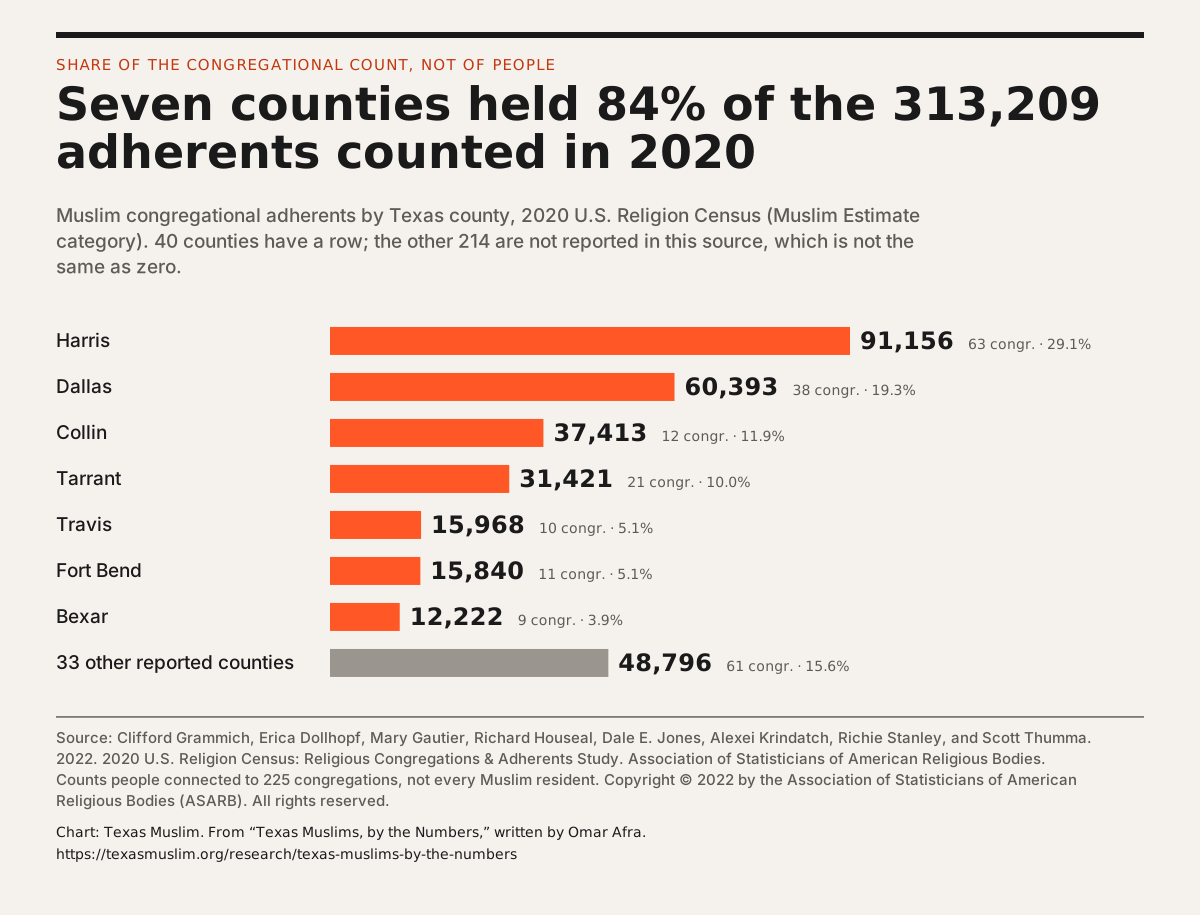
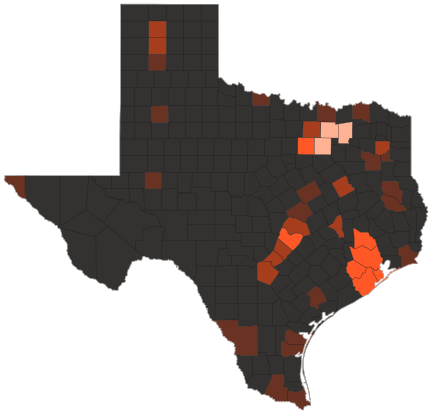
For geography, the 2020 Religion Census is the most useful source because it reports county by county. In Harris County it recorded 91,156 Muslim adherents in 63 congregations; in Dallas County, 60,393 in 38. Those two counties alone account for nearly half of the state’s adherents in that study. [3][6][7]
The more revealing figure is a rate. Collin County, north of Dallas, recorded 37,413 adherents, or 35.15 per 1,000 residents, the highest rate of any Texas county in the study and well above Harris County’s 19.27. Fort Bend County, southwest of Houston, sits almost level with Harris on that measure at 19.25. Tarrant County recorded 14.89 per 1,000, and Travis County, home to Austin, 12.38. [6][7][8][9][10][11]
Only 40 of the state’s 254 counties have a Muslim Estimate row at all, though those 40 were home to about 81% of Texans in 2020. The second-highest rate belongs to a less obvious place: Hunt County, east of Dallas, where 3,018 adherents in two congregations come to 30.19 per 1,000. The other 214 counties are blank in the source, which is not the same as empty; a county with no reported congregation can still have Muslim neighbors. The full table, sortable by number or by share, is in the county explorer. [21]
The pattern will not surprise anyone who has looked for parking at Friday prayer in Plano or Sugar Land: much of Muslim Texas is suburban. The national mosque survey found the same shift across the country, with fewer mosques downtown and more in older and newer suburbs between 2010 and 2020. [5]
County lines still matter. A Harris County figure is not a City of Houston figure, and a Dallas County figure leaves out Plano, most of which sits in Collin. When a story says “Houston” or “Dallas,” it is worth asking which map the number was drawn on.
Share of the congregational count, not of people
Seven counties held 84% of the 313,209 adherents counted in 2020
| County | Adherents (congregations) | Share of reported adherents | Running total |
|---|---|---|---|
| Harris | 91,156 (63) | 29.1% of reported adherents | 29.1% running total |
| Dallas | 60,393 (38) | 19.3% of reported adherents | 48.4% running total |
| Collin | 37,413 (12) | 11.9% of reported adherents | 60.3% running total |
| Tarrant | 31,421 (21) | 10.0% of reported adherents | 70.4% running total |
| Travis | 15,968 (10) | 5.1% of reported adherents | 75.5% running total |
| Fort Bend | 15,840 (11) | 5.1% of reported adherents | 80.5% running total |
| Bexar | 12,222 (9) | 3.9% of reported adherents | 84.4% running total |
| 33 other reported counties | 48,796 (61) | 15.6% of reported adherents | 100.0% running total |
Shares are of the 313,209 congregational adherents in the 2020 U.S. Religion Census, which counts people connected to 225 congregations, not every Muslim resident. The 214 counties without a Muslim Estimate row are not reported in this source, not zero. Every county, sortable.
Source: 2020 U.S. Religion Census (ASARB, released June 23, 2023, retrieved November 9, 2026). Copyright © 2022 by the Association of Statisticians of American Religious Bodies (ASARB). All rights reserved.
Download this chart
Chart: Texas Muslim. From “Texas Muslims, by the Numbers,” written by Omar Afra. Please credit Texas Muslim and link to the article. Data: 2020 U.S. Religion Census, Association of Statisticians of American Religious Bodies (Copyright © 2022 by the Association of Statisticians of American Religious Bodies (ASARB). All rights reserved.). Attribution required; the data are not relicensed here.
All 254 counties, 2020
Where Texas Muslim congregations count the most people — and where they are the largest share
| Rank | Most adherents (congregations) | Highest share of county population |
|---|---|---|
| 1 | Harris 91,156 (63) | Collin 3.515% (35.15 per 1,000) |
| 2 | Dallas 60,393 (38) | Hunt 3.019% (30.19 per 1,000) |
| 3 | Collin 37,413 (12) | Dallas 2.311% (23.11 per 1,000) |
| 4 | Tarrant 31,421 (21) | Harris 1.927% (19.27 per 1,000) |
| 5 | Travis 15,968 (10) | Fort Bend 1.925% (19.25 per 1,000) |
| 6 | Fort Bend 15,840 (11) | Tarrant 1.489% (14.89 per 1,000) |
| 7 | Bexar 12,222 (9) | Galveston 1.311% (13.11 per 1,000) |
| 8 | Montgomery 7,545 (5) | Travis 1.238% (12.38 per 1,000) |
| 9 | Denton 6,868 (5) | Montgomery 1.216% (12.16 per 1,000) |
| 10 | Williamson 5,432 (4) | Brazoria 1.107% (11.07 per 1,000) |
Estimated congregational adherents in the 2020 U.S. Religion Census, not a 2026 head count of every Muslim resident. 40 of 254 counties have a Muslim Estimate row; the other 214 are not reported in this source, which is not the same as zero. Reported rows total 225 congregations and 313,209 adherents. Search and sort every county.
Source: 2020 U.S. Religion Census (ASARB, released June 23, 2023, retrieved November 9, 2026). Copyright © 2022 by the Association of Statisticians of American Religious Bodies (ASARB). All rights reserved.
Mosques are institutions, not pins
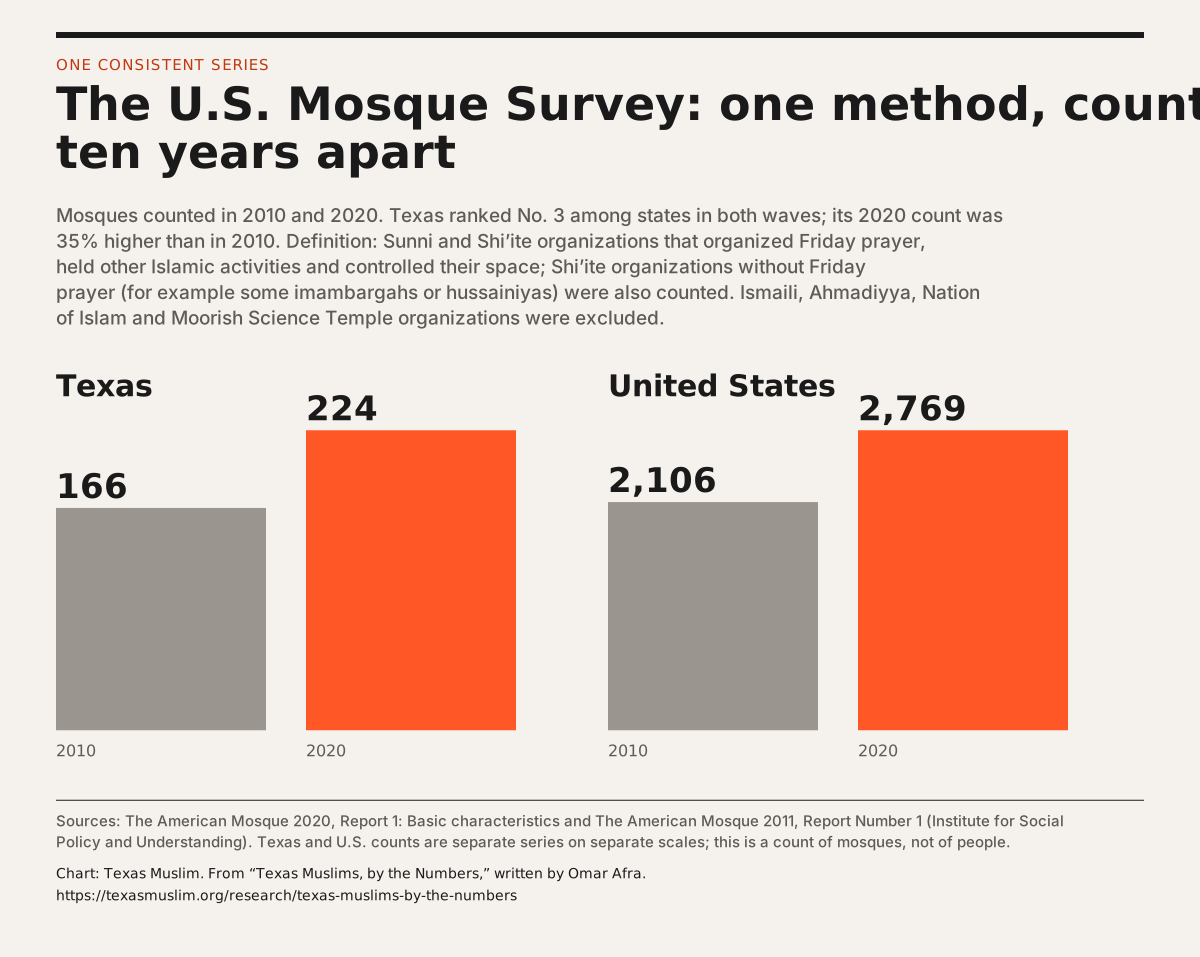
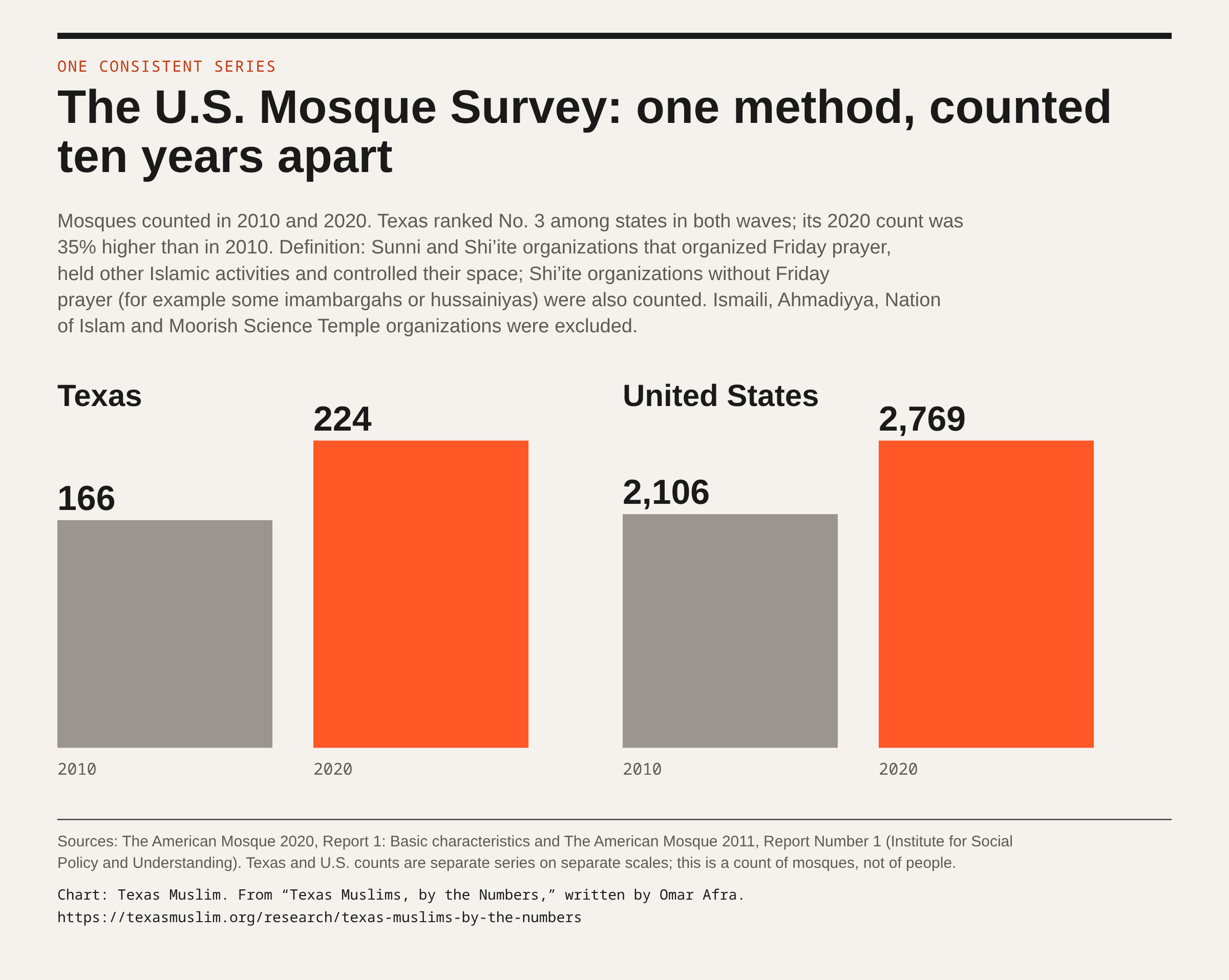
The same care applies to mosques. The U.S. Mosque Survey, conducted every decade with the same basic method, counted 224 mosques in Texas in 2020. That was the third-highest total of any state, behind New York and California, up 35% from the 166 it counted in Texas in 2010. Nationally, its count rose from 2,106 to 2,769 over the same decade. [5][22]
That survey is the only consistent historical series used here, and it has edges. It counted Sunni and Shi’ite organizations that organized Friday prayer, ran other Islamic activities and controlled their own space, so a hospital or airport room used only for Friday prayer did not qualify. The survey made one deliberate exception: Shi’ite organizations without Friday prayer, including some that consider themselves an imambargah or hussainiya, were still counted as mosques. Ismaili, Ahmadiyya, Nation of Islam and Moorish Science Temple organizations were left out. Those are the boundaries of one study, not judgments about who belongs. [5]
A mosque is rarely only a prayer hall. Many Texas centers also run classes and youth programs; some operate full-time schools, clinics or funeral services. That is why a mosque count says less about population than about institution-building: how many groups of neighbors raised money, bought or built a space and kept the lights on.
One consistent series
The U.S. Mosque Survey: one method, counted ten years apart
| Measure | 2010 | 2020 |
|---|---|---|
| Texasmosques | 166 | 224 |
| United Statesmosques | 2,106 | 2,769 |
| African American mosquesshare of U.S. mosques | 23% | 13% |
U.S. Mosque Survey (2010 and 2020 waves, same basic method). Texas ranked third among states in both waves, and its 2020 count was 35% higher than in 2010. The African American share is national, not a Texas figure. Definition: Sunni and Shi’ite organizations that organized Friday prayer, held other Islamic activities and controlled their space; Shi’ite organizations without Friday prayer (for example some imambargahs or hussainiyas) were also counted. Ismaili, Ahmadiyya, Nation of Islam and Moorish Science Temple organizations were excluded.
Sources: The American Mosque 2020, Report 1: Basic characteristics (Institute for Social Policy and Understanding, checked November 9, 2026) · The American Mosque 2011, Report Number 1 (Institute for Social Policy and Understanding, checked November 9, 2026)
Download this chart
Chart: Texas Muslim. From “Texas Muslims, by the Numbers,” written by Omar Afra. Please credit Texas Muslim and link to the article. Data: U.S. Mosque Survey (Institute for Social Policy and Understanding). See the producer’s reports for terms of use.
The count keeps moving
Online directories update faster than any survey, and they disagree. MosqueIndex listed 282 Texas mosques in 79 cities when it was checked in September 2026. Fajr Labs showed 332 Texas listings that month and 289 when it was checked again on October 26, 2026. A directory total can move by dozens in a month without a single congregation opening or closing. It measures the directory as much as the community. Resolutions introduced in the Legislature in 2023 and 2025 recite more than 338 and more than 330 mosques and Islamic centers. [19][17][20][4]
New institutions do open, and some are large. IslamInSpanish completed the grand opening of its Centro Islámico in Houston in November 2024, and Ismaili Center Houston was inaugurated in November 2025, adding a major religious and cultural landmark to the city. Announcements, land purchases and building plans are a different matter: until a place is operating, it belongs on a timeline, not in a count. [23][16]
Texas Muslim keeps its own register of mosque and prayer-space campuses, each checked against an address the operator publishes. It is deliberately a selected list rather than a statewide total, and its value is that every entry can be traced to a source. The charts below show how those documented campuses fall across the state’s regions, beside the directory snapshots.
Snapshots, not a series
Texas mosque counts by source and date
| Source | Count | What it counts |
|---|---|---|
| U.S. Mosque Survey2020 | 224 | Mosques meeting the survey’s definition |
| MosqueIndexChecked September 22, 2026 | 282 | Listed mosques across 79 cities |
| Fajr LabsChecked September 22, 2026 | 332 | Directory listings, 116 cities |
| Fajr LabsChecked October 26, 2026 | 289 | Directory listings, 110 cities |
| HCR 80, introduced2023 | More than 338 | Mosques and Islamic centers recited in a resolution |
| HCR 18, introduced2025 | More than 330 | Mosques and Islamic centers recited in a resolution |
| Texas Muslim registerRelease 2026.4, October 26, 2026 | 83 | Selected campuses, each checked against the operator’s published address; not a statewide total. Mosque map |
“More than” figures are shown at their stated floor. Directory totals change as listings are added, merged or removed.
Sources: The American Mosque 2020, Report 1: Basic characteristics (Institute for Social Policy and Understanding, checked November 9, 2026) · Mosques in Texas (MosqueIndex, checked September 22, 2026) · Texas masjid map (Fajr Labs, checked October 26, 2026) · HCR 80, introduced text, 88th Legislature, 2023 (Texas Legislature, checked September 22, 2026) · HCR 18, introduced text, 89th Legislature, 2025 (Texas Legislature, checked November 9, 2026)
Compare regions
Four metros: county figures, directory counts and documented campuses
| Region | County adherents, 2020 (congregations) | Directory count | Documented in our register |
|---|---|---|---|
| Houston | Harris: 91,156 (63)Fort Bend: 15,840 (11) | 116 campuses, 17 citiesFajr Labs, October 26, 2026 | 25 on the map |
| Dallas–Fort Worth | Dallas: 60,393 (38)Collin: 37,413 (12)Tarrant: 31,421 (21) | 108 masjids, 39 citiesFajr Labs, September 2026 | 25 on the map |
| Austin | Travis: 15,968 (10)Williamson: 5,432 (4) | No separate figure | 11 on the map |
| San Antonio | Bexar: 12,222 (9) | No separate figure | 6 on the map |
County, city and metro are different areas: a county figure is not a city figure, and suburbs often sit in neighboring counties. The register column counts campuses in Texas Muslim’s selected, source-checked list (release 2026.4); it is not a complete metro count.
Sources: Harris County, 2020 U.S. Religion Census (Association of Religion Data Archives, checked October 3, 2026) · Fort Bend County, 2020 U.S. Religion Census (Association of Religion Data Archives, checked October 3, 2026) · Dallas County, 2020 U.S. Religion Census (Association of Religion Data Archives, checked October 3, 2026) · Collin County, 2020 U.S. Religion Census (Association of Religion Data Archives, checked October 3, 2026) · Tarrant County, 2020 U.S. Religion Census (Association of Religion Data Archives, checked October 3, 2026) · Travis County, 2020 U.S. Religion Census (Association of Religion Data Archives, checked October 3, 2026) · 2020 U.S. Religion Census, Group by County workbook (U.S. Religion Census (ASARB), checked November 9, 2026) · Texas masjid map (Fajr Labs, checked October 26, 2026)
Older than the headlines
Numbers also flatten time. Muslim Texas did not begin with recent immigration. Dallas’s Masjid Al-Islam traces its community to the Nation of Islam in the 1950s, when it was known as Temple No. 48, and its own chronology describes a transition toward Sunni Islam in 1975. The University of Houston’s Muslim Student Association dates to 1964. The Islamic Society of Greater Houston and the Islamic Association of North Texas both date their beginnings to 1969. [12][13][14][15]
Black Muslim congregations are part of that foundation, and national data suggest their share of mosques has shrunk. The U.S. Mosque Survey found that African American mosques made up 23% of American mosques in 2010 and 13% in 2020. That is a national figure, not a Texas one, but it is a reminder that the newest and most visible buildings are not the whole story. [5]
Dated milestones, not a count
Texas Muslim institutions: founded, incorporated, built and opened
| Date | Milestone | Place and event |
|---|---|---|
| 1950s | Founded | Dallas Masjid Al-Islam traces its beginnings to Temple No. 48 of the Nation of Islam. Masjid Al-Islam, Dallas |
| 1964 | Established | Houston The University of Houston Muslim Student Association is established, a student group rather than a mosque. University of Houston, A.D. Bruce Religion Center |
| 1969 | Established | Houston The Islamic Society of Greater Houston says it was established by University of Houston students and professionals. Islamic Society of Greater Houston |
| 1969 | Established | Richardson The Islamic Association of North Texas says it was established. Islamic Association of North Texas |
| 1975 | Changed tradition | Dallas Masjid Al-Islam’s congregation moves to Sunni Islam. Masjid Al-Islam, Dallas |
| 1991 | Established | Irving The Islamic Center of Irving says it was established. Islamic Center of Irving |
| 1996 | Founded | Houston (Clear Lake) Clear Lake Islamic Center dates its origins. Clear Lake Islamic Center |
| 2000 | Incorporated | Houston (Clear Lake) Clear Lake Islamic Center is incorporated. Clear Lake Islamic Center |
| 2003 | Founded | Sugar Land Masjid Maryam’s official site says it was founded. Masjid Maryam |
| June 2008 | Construction began | Houston (Clear Lake) Construction begins on Clear Lake Islamic Center’s building. Clear Lake Islamic Center |
| November 16, 2024 | Opened | Houston IslamInSpanish completes the grand opening of its Centro Islámico. IslamInSpanish |
| November 6, 2025 | Inaugurated | Houston Ismaili Center Houston is inaugurated. Aga Khan Development Network |
| November 13, 2026 | Announced | Austin Nueces Mosque has announced its final Jumu’ah at its current building ahead of reconstruction; the temporary venue had not been published when checked. Nueces Mosque |
Founding, incorporation, construction and opening are different events, so the list labels each one. It is a selection of documented dates, not an annual statewide total.
Sources: History (Masjid Al-Islam, Dallas, checked October 24, 2026) · Student Organizations: Muslim Student Association (University of Houston, A.D. Bruce Religion Center, checked October 24, 2026) · About (Islamic Society of Greater Houston, checked October 24, 2026) · About us (Islamic Association of North Texas, checked October 24, 2026) · About us (Islamic Center of Irving, checked October 24, 2026) · Our history (Clear Lake Islamic Center, checked November 9, 2026) · Masjid Maryam official website (Masjid Maryam, checked October 24, 2026) · Centro Islámico grand opening, November 16, 2024 (IslamInSpanish, checked November 9, 2026) · Ismaili Center Houston inauguration, November 6, 2025 (Aga Khan Development Network, checked September 22, 2026) · Reconstruction announcement (Nueces Mosque, checked October 24, 2026)
How to read the next headline
When a number about Muslim Texans appears, four questions clear up most of the confusion. What year does it describe? What does it count: adults who answered a survey, people connected to congregations, or buildings? What area does it cover: a city, a county or a metro? And who produced it?
Ask those, and the numbers stop competing. Pew’s 2% describes adults in 2023–24. The Religion Census describes congregations and their adherents in 2020. The Mosque Survey describes institutions under one definition. A resolution describes what its sponsors chose to recite. Together they describe a community that is large, rooted and still building, which is a better headline than any single number.
The full comparisons live in How many Muslims live in Texas?, How many mosques are in Texas? and Texas Muslim communities by county. Regional guides cover Houston, Dallas–Fort Worth, Austin and San Antonio, and the mosque map lists documented campuses with their sources. The longer story is in Texas Muslim history.
Get the facts behind Texas headlines.
An occasional email from Texas Muslim with new research, data guides and corrections.
About this story
Every figure is shown with its source, reference year and unit. Figures from different sources are not combined into a trend. County figures come from the 2020 U.S. Religion Census; mosque change over time comes only from the U.S. Mosque Survey.
Sources
- 12023–24 Religious Landscape Study: adults in Texas — Pew Research Center · retrieved 2026-11-09 ↩
- 2Muslims, Handbook of Texas — Texas State Historical Association · retrieved 2026-11-09 ↩
- 32020 U.S. Religion Census, Texas state membership report — Association of Religion Data Archives · retrieved 2026-11-09 ↩
- 4HCR 18, introduced text, 89th Legislature, 2025 — Texas Legislature · retrieved 2026-11-09 ↩
- 5The American Mosque 2020, Report 1: Basic characteristics — Institute for Social Policy and Understanding · retrieved 2026-11-09 ↩
- 6Harris County, 2020 U.S. Religion Census — Association of Religion Data Archives · retrieved 2026-10-03 ↩
- 7Dallas County, 2020 U.S. Religion Census — Association of Religion Data Archives · retrieved 2026-10-03 ↩
- 8Collin County, 2020 U.S. Religion Census — Association of Religion Data Archives · retrieved 2026-10-03 ↩
- 9Tarrant County, 2020 U.S. Religion Census — Association of Religion Data Archives · retrieved 2026-10-03 ↩
- 10Fort Bend County, 2020 U.S. Religion Census — Association of Religion Data Archives · retrieved 2026-10-03 ↩
- 11Travis County, 2020 U.S. Religion Census — Association of Religion Data Archives · retrieved 2026-10-03 ↩
- 12History — Masjid Al-Islam, Dallas · retrieved 2026-10-24 ↩
- 13Student Organizations: Muslim Student Association — University of Houston, A.D. Bruce Religion Center · retrieved 2026-10-24 ↩
- 14About — Islamic Society of Greater Houston · retrieved 2026-10-24 ↩
- 15About us — Islamic Association of North Texas · retrieved 2026-10-24 ↩
- 16Ismaili Center Houston inauguration, November 6, 2025 — Aga Khan Development Network · retrieved 2026-09-22 ↩
- 17Texas masjid map — Fajr Labs · retrieved 2026-10-26 ↩
- 18Why the U.S. census doesn’t ask Americans about their religion — Pew Research Center · retrieved 2026-09-22 ↩
- 19Mosques in Texas — MosqueIndex · retrieved 2026-09-22 ↩
- 20HCR 80, introduced text, 88th Legislature, 2023 — Texas Legislature · retrieved 2026-09-22 ↩
- 212020 U.S. Religion Census, Group by County workbook — U.S. Religion Census (ASARB) · retrieved 2026-11-09 ↩
- 22The American Mosque 2011, Report Number 1 — Institute for Social Policy and Understanding · retrieved 2026-11-09 ↩
- 23Centro Islámico grand opening, November 16, 2024 — IslamInSpanish · retrieved 2026-11-09 ↩
About this work
Omar Afra wrote this feature and chose how its figures are compared. The counts belong to their producers: the U.S. Mosque Survey (ISPU), the 2020 U.S. Religion Census (ASARB), Pew Research Center, the Handbook of Texas and the Texas Legislature. Texas Muslim drew the charts from those published figures.
Cite this page
Afra, Omar. “Texas Muslims, by the Numbers: What the Headlines Leave Out.” Texas Muslim, November 9, 2026. Updated November 13, 2026. https://texasmuslim.org/research/texas-muslims-by-the-numbers.
About the author
Omar Afra is a Houston-based publisher and the founder and editor of Texas Muslim. He publishes Testset and Live Index and founded Free Press Houston.