Texas law promises equal protection for worship. Three disputes involving Muslim Texans, over a cemetery in Farmersville, funeral rites in Plano and a school-funding deadline, show what that promise looks like on paper and how much each document actually decides.
Seven kinds of paper
When a religious-freedom fight reaches the news, it usually arrives as a single verdict: a city “discriminated,” an agency “cracked down,” a judge “ruled for” a mosque. The record underneath is rarely that tidy. It is a stack of different documents, written by different people for different purposes, and each one settles a different amount.
A constitutional clause states a promise. An agency letter announces what the agency believes, and a federal investigator’s notice announces what the investigator concluded. A complaint tells one side’s story. A temporary restraining order freezes a situation for days so a court can look closer. An order on a motion to dismiss decides whether a lawsuit has said enough to continue; for that purpose it accepts the complaint’s well-pleaded facts as true, though not its legal conclusions. A settlement ends a dispute on terms both sides sign, sometimes while one side denies everything. Rulings along the way can settle particular legal questions, but it takes a final judgment on the merits to resolve the claims themselves.
Collapsing those into one headline does damage in both directions. It can turn an allegation into a finding, and it can shrink a real court ruling into “just an accusation.” This guide takes three Texas disputes, puts their documents in order and shows, page by page, what each one establishes. [5][6][7][8]
How to read the record
Seven kinds of paper, and what each one decides
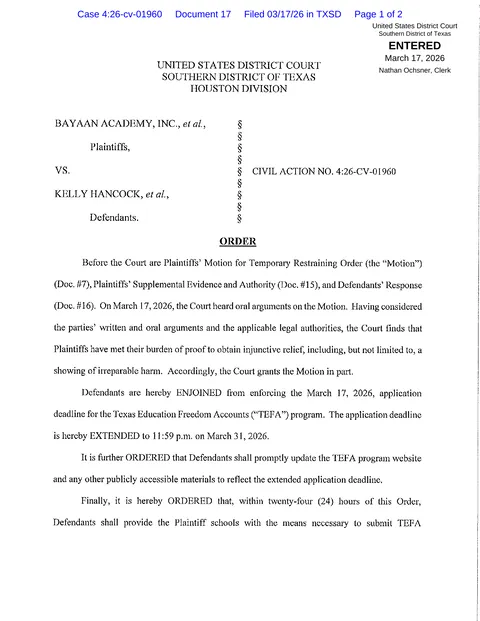
- Constitutional or statutory promise
Decides States the rule.
Does not Decide any dispute.
Here Texas Constitution Art. I §6; CPRC ch. 110; RLUIPA
- Government letter, notice or vote
Decides States a government body’s position, conclusion or decision.
Does not Bind a court or prove the facts.
Here Farmersville council votes; DOJ notices; TFSC cease-and-desist letter
- Complaint or motion
Decides Sets out one side’s allegations, claims or requests.
Does not Prove anything by being filed.
Here United States v. Farmersville; EPIC’s complaint; motions to dismiss
- Emergency order (TRO)
Decides Freezes or adjusts a situation for days, or declines to.
Does not Resolve the claims or decide who finally prevails.
Here Bayaan Academy, March 17 and March 31, 2026
- Order on a motion to dismiss
Decides Whether the complaint’s well-pleaded facts, accepted as true, state a claim that may proceed.
Does not Find the alleged facts true.
Here EPIC, June 24, 2026
- Settlement
Decides Ends a dispute on terms the parties sign.
Does not Amount to a court finding; denials can stand.
Here Farmersville, April 16, 2019
- Final judgment on the merits
Decides Resolves the substantive claims on the facts and the law.
Does not Earlier orders can decide particular legal questions; this one resolves the claims.
Here None in the documents shown here
Not a ladder: a case can skip steps, settle at any point or end without a merits ruling. Labels describe the documents in this article.
What the state already promises
Texas does not lack religious-freedom law. Article I, Section 6 of the state constitution says that “no preference shall ever be given by law to any religious society or mode of worship,” and it directs the Legislature to pass the laws needed to protect every denomination equally in its peaceable public worship. A 2021 amendment, Section 6-a, bars the state and local governments from orders that prohibit or limit religious services. [1]
The Texas Religious Freedom Restoration Act, Chapter 110 of the Civil Practice and Remedies Code, says a government agency may not substantially burden a person’s free exercise of religion unless it shows that the burden furthers a compelling governmental interest by the least restrictive means. It is a test, not a blanket exemption from ordinary rules. Its remedies section caps compensatory damages at $10,000 for each entire, distinct controversy, separately from attorney’s fees and court costs, and a later section preserves cities’ zoning and land-use authority as federal courts understood it before April 17, 1990. [2]
Federal law adds the Religious Land Use and Institutionalized Persons Act. In the Justice Department’s summary, its land-use provisions bar substantial burdens on religious exercise that are not justified by a compelling interest pursued in the least restrictive way, require religious assemblies to be treated at least as well as nonreligious ones, and forbid religious discrimination, total exclusion and unreasonable limits. Those protections apply under conditions the statute sets; they are not a pass from every zoning rule. That is the promise, and the three cases below show what happens when someone tests it. [3]
Three Texas disputes
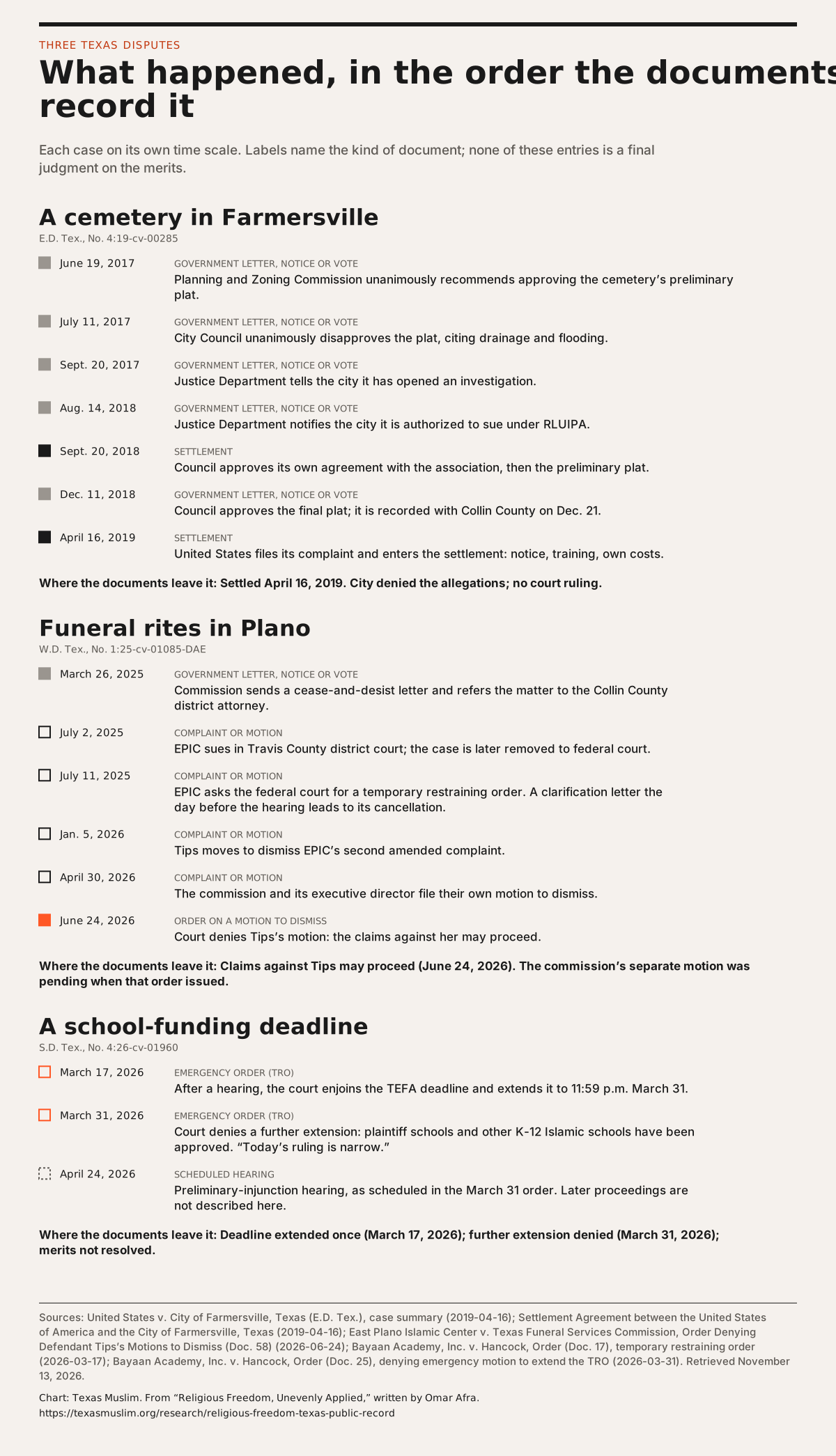
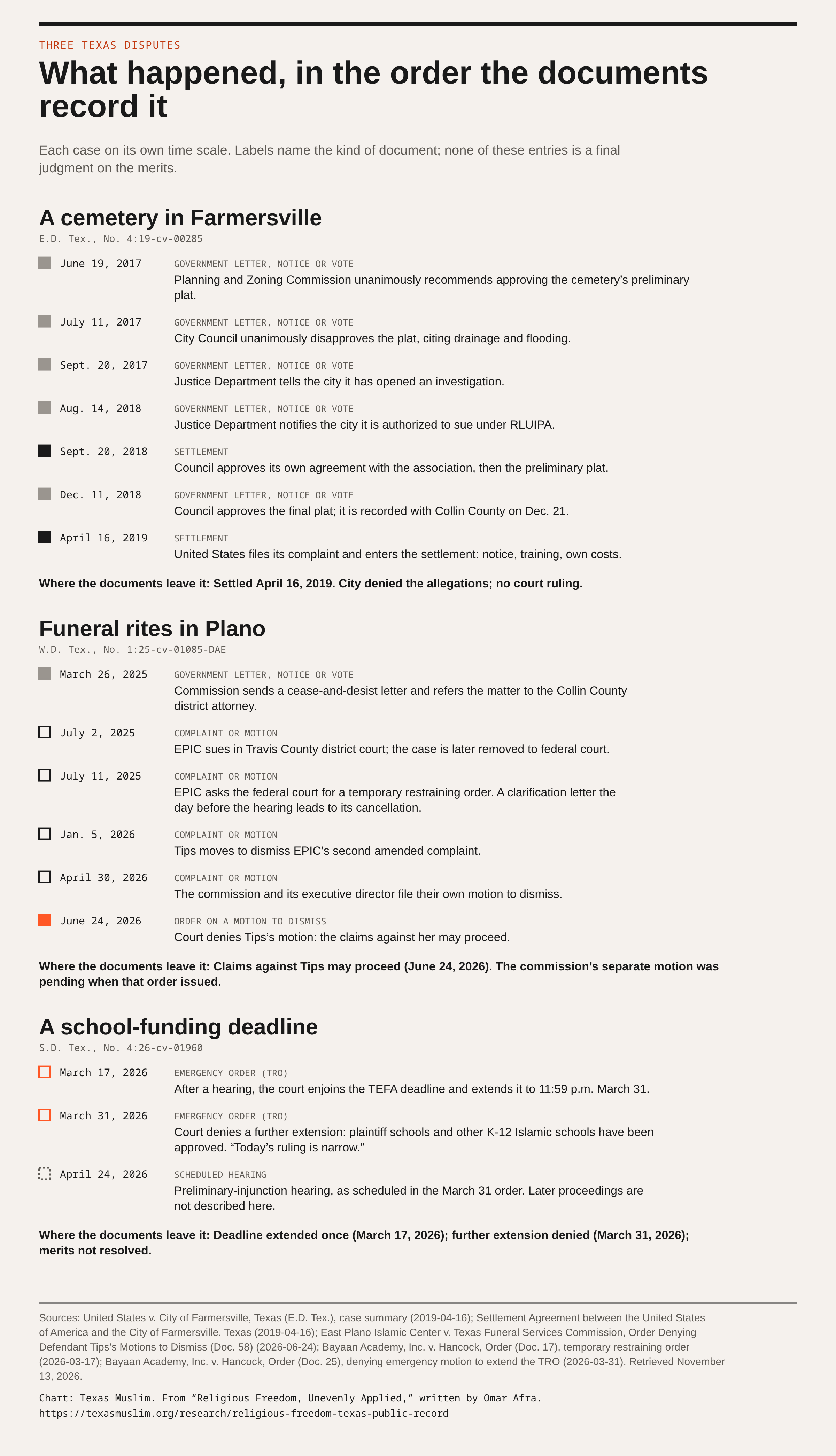
What happened, in the order the documents record it
E.D. Tex., No. 4:19-cv-00285
Where the documents leave it Settled April 16, 2019. City denied the allegations; no court ruling.
- Government letter, notice or vote
Planning and Zoning Commission unanimously recommends approving the cemetery’s preliminary plat. Settlement agreement, p. 2 (opens the original document)
- Government letter, notice or vote
City Council unanimously disapproves the plat, citing drainage and flooding. Settlement agreement, p. 3 (opens the original document)
- Government letter, notice or vote
Justice Department tells the city it has opened an investigation. Settlement agreement, p. 3 (opens the original document)
- Government letter, notice or vote
Justice Department notifies the city it is authorized to sue under RLUIPA. Settlement agreement, p. 4 (opens the original document)
- Settlement
Council approves its own agreement with the association, then the preliminary plat. Settlement agreement, p. 5 (opens the original document)
- Government letter, notice or vote
Council approves the final plat; it is recorded with Collin County on Dec. 21. Settlement agreement, p. 5 (opens the original document)
- Settlement
United States files its complaint and enters the settlement: notice, training, own costs. Settlement agreement, p. 7 (opens the original document)
W.D. Tex., No. 1:25-cv-01085-DAE
Where the documents leave it Claims against Tips may proceed (June 24, 2026). The commission’s separate motion was pending when that order issued.
- Government letter, notice or vote
Commission sends a cease-and-desist letter and refers the matter to the Collin County district attorney. EPIC order, Doc. 58, p. 3 (opens the original document)
- Complaint or motion
EPIC sues in Travis County district court; the case is later removed to federal court. EPIC order, Doc. 58, p. 4 (opens the original document)
- Complaint or motion
EPIC asks the federal court for a temporary restraining order. A clarification letter the day before the hearing leads to its cancellation. EPIC order, Doc. 58, p. 4 (opens the original document)
- Complaint or motion
Tips moves to dismiss EPIC’s second amended complaint. EPIC order, Doc. 58, p. 5 (opens the original document)
- Complaint or motion
The commission and its executive director file their own motion to dismiss. EPIC order, Doc. 58, p. 5 (opens the original document)
- Order on a motion to dismiss
Court denies Tips’s motion: the claims against her may proceed. EPIC order, Doc. 58, p. 26 (opens the original document)
S.D. Tex., No. 4:26-cv-01960
Where the documents leave it Deadline extended once (March 17, 2026); further extension denied (March 31, 2026); merits not resolved.
- Emergency order (TRO)
After a hearing, the court enjoins the TEFA deadline and extends it to 11:59 p.m. March 31. School order, Doc. 17, p. 1 (opens the original document)
- Emergency order (TRO)
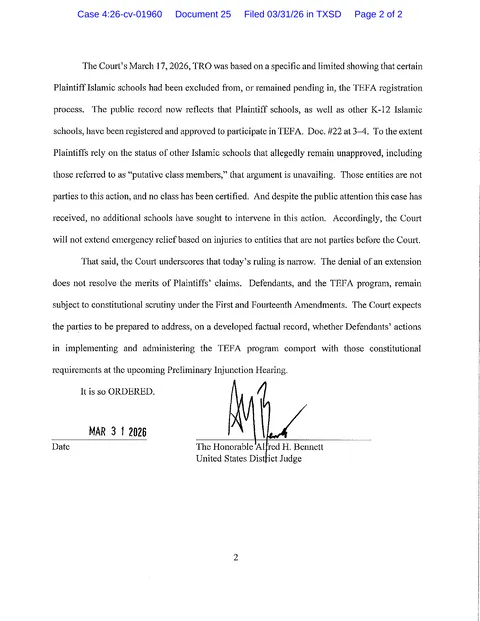
Court denies a further extension: plaintiff schools and other K-12 Islamic schools have been approved. “Today’s ruling is narrow.” School order, Doc. 25, p. 2 (opens the original document)
- Scheduled hearing
Preliminary-injunction hearing, as scheduled in the March 31 order. Later proceedings are not described here. School order, Doc. 25, p. 1 (opens the original document)
Each case is drawn on its own time scale. Dates and page references are from the documents linked; no later filings are described.
Download this chart
Chart: Texas Muslim. From “Religious Freedom, Unevenly Applied,” written by Omar Afra. Please credit Texas Muslim and link to the article. Primary documents: U.S. Department of Justice; U.S. District Courts for the Western and Southern Districts of Texas. Court orders are public records.
Farmersville: a cemetery, a culvert and a settlement
In 2017 the Islamic Association of Collin County asked Farmersville, a small city northeast of Dallas, to approve a preliminary plat for a cemetery. The settlement agreement later signed by the city and the United States lays out the sequence. The city’s Planning and Zoning Commission voted unanimously on June 19, 2017, to recommend approval. On July 11, the City Council voted unanimously to disapprove the plat, citing drainage and flooding. The agreement records the association’s engineer saying that an undersized culvert under County Road 557 was Collin County’s to upgrade, and a survey showing storm water backing up about 215 feet onto the land. [5]
The Justice Department told the city on September 20, 2017, that it had opened an investigation. In August 2018, according to the department’s case summary, it notified the city that it had concluded the city violated RLUIPA and intended to sue. The city and the association then reached their own agreement: the association accepted limits on the flood-prone part of the property, and the council approved the preliminary plat on September 20, 2018, and the final plat on December 11, 2018. On April 16, 2019, the United States filed its complaint and entered into its settlement with the city. [4][5]
Here the kind of paper matters. The complaint alleged a substantial burden and religious discrimination. The settlement says in its second paragraph that the city “vigorously denies” those allegations, and its long recital section, much of it about storm water, reads as the city’s account of events. What the city agreed to do is short: post a notice in City Hall that it applies its zoning rules in compliance with RLUIPA, and within 90 days give at least an hour of RLUIPA training to the people who handle zoning and land use. Each side bore its own costs, and the United States agreed to dismiss its suit once the notice went up. The settlement is an agreement between the parties, not a judicial finding that Farmersville discriminated. The land was cleared for a cemetery by the city’s own approvals, made while a federal investigation was open, after the city first said no. [4][5]
Inside the Farmersville settlement
Forty paragraphs: most of it recital, two of them obligations
- Introduction ¶1–4 · pp. 1–2
Parties, the dismissal mechanism and the city’s denial (¶2).
- Recitals ¶5–29 · pp. 2–6
The 2017–2018 plat history, much of it about storm water, as the parties set it out.
- Binding obligations ¶30–31 · p. 7
A RLUIPA notice in City Hall; one hour of training within 90 days.
- Litigation hold ends ¶32 · p. 7
Document holds released.
- Duration and terms ¶33–40 · pp. 8–9
Effective date; each side bears its own costs (¶34); public disclosure (¶39).
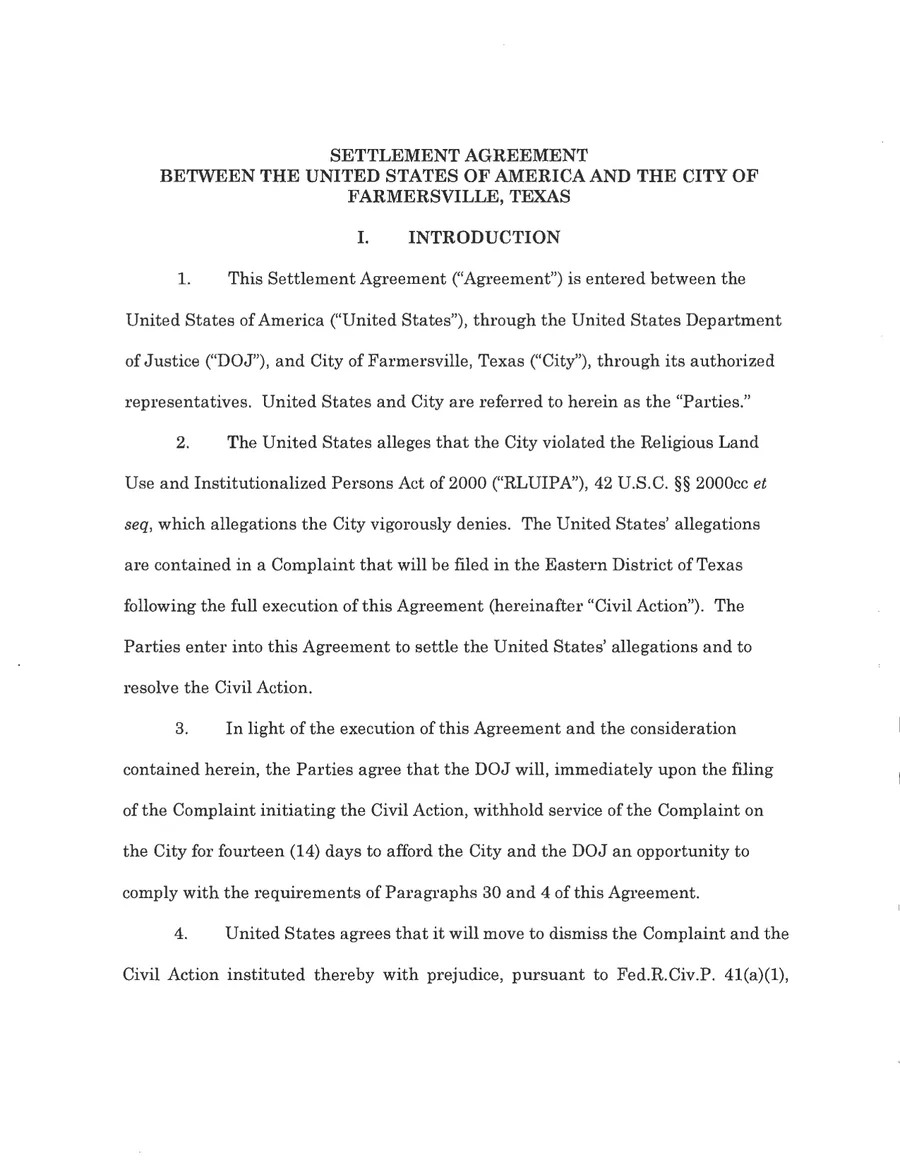
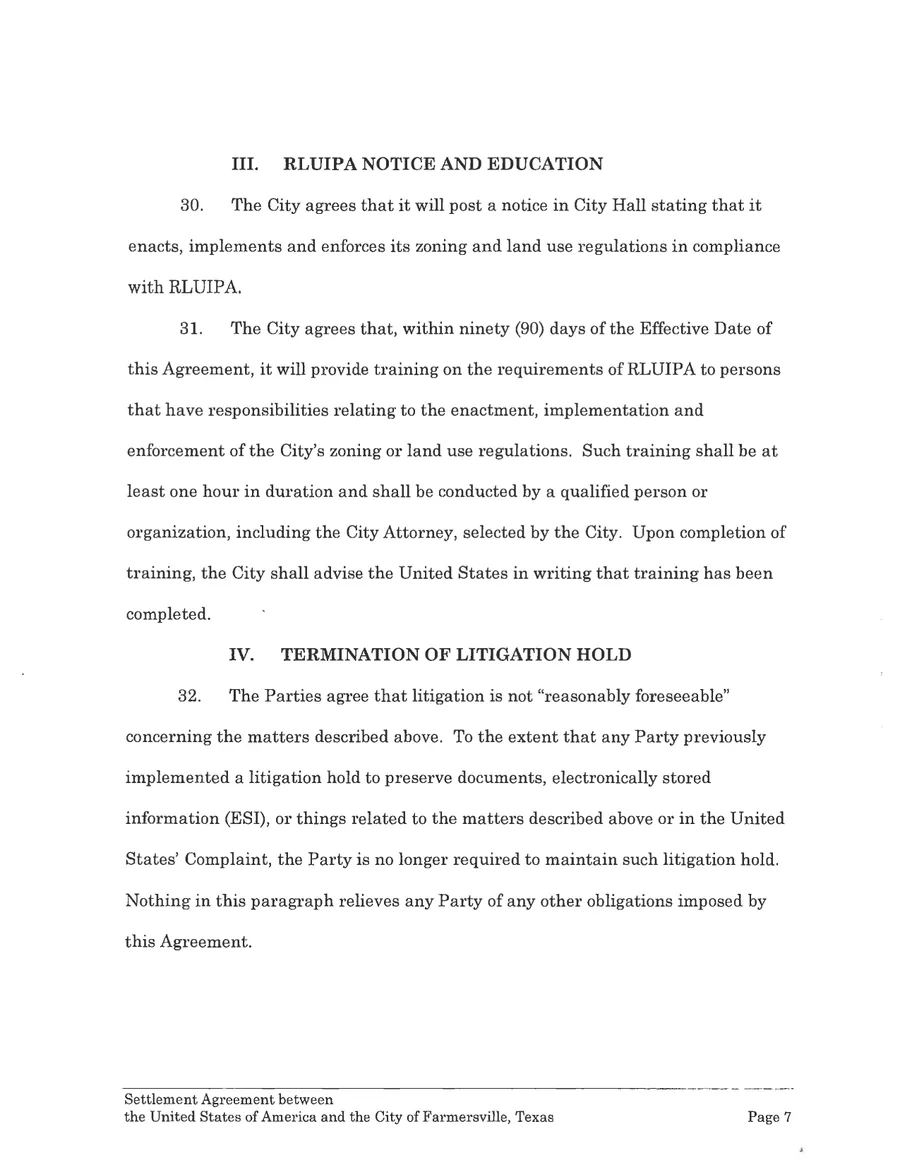
Source: Settlement agreement, United States and City of Farmersville (U.S. Department of Justice, April 16, 2019, 11 pages; retrieved November 13, 2026). Paragraph counts from the document itself. [5]
Plano: funeral rites and a motion that failed
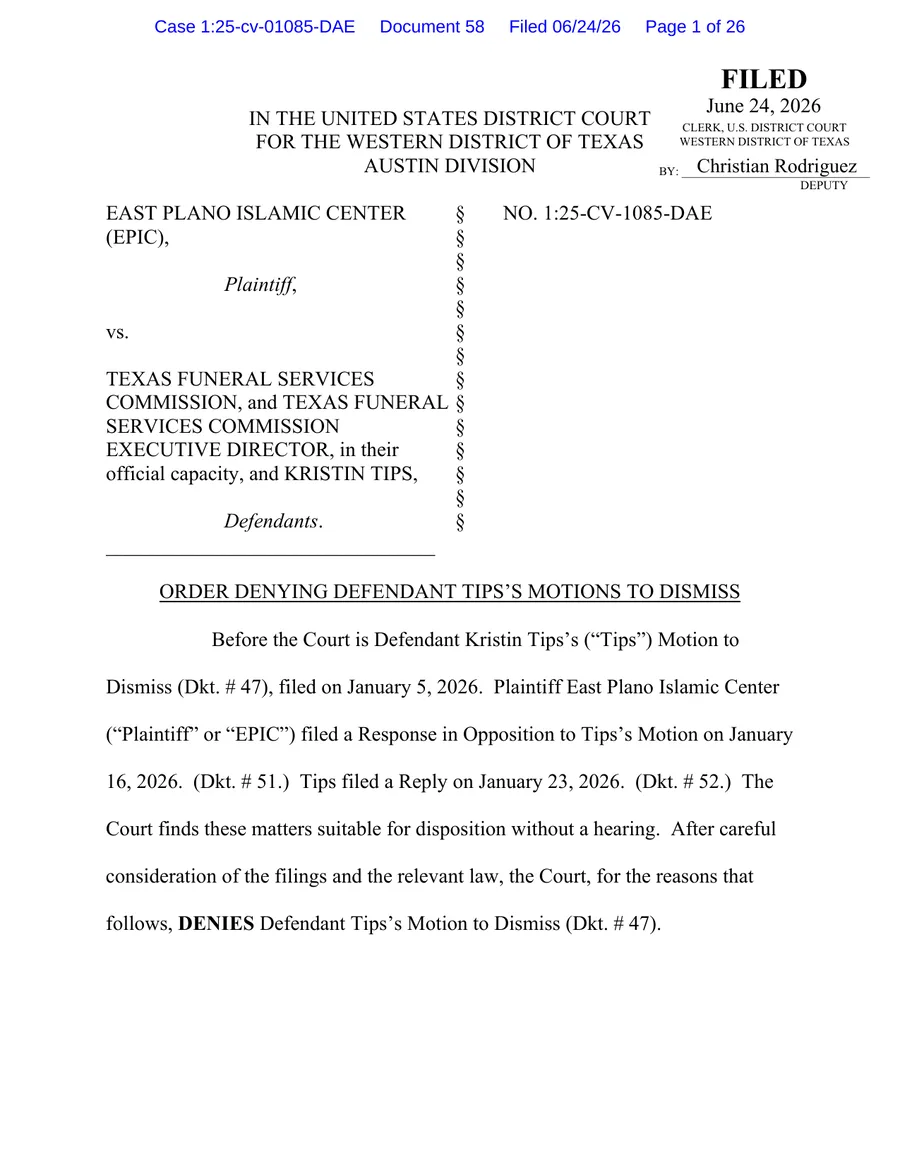
The second case concerns the East Plano Islamic Center, known as EPIC. On June 24, 2026, Senior U.S. District Judge David Alan Ezra, sitting in Austin, denied a motion to dismiss filed by Kristin Tips, one of the defendants. The 26-page order is worth reading for what it does and for what it leaves alone. [6]
Its background section summarizes EPIC’s complaint. EPIC says it helps families with washing, shrouding and the Janaza prayer, in partnership with licensed funeral providers and on a non-commercial basis. On March 26, 2025, the Texas Funeral Service Commission sent EPIC a cease-and-desist letter accusing it of operating a funeral establishment without a license and referring the matter to the Collin County district attorney; the order notes that the letter did not say which practices were unlawful. EPIC says it stopped its rites, and that at least eleven congregants were buried without receiving the Janaza prayer at their mosque. The day before a hearing on EPIC’s July 2025 request for emergency relief, the commission issued a letter clarifying the scope of the first one, and the hearing was cancelled. [6]
Those are allegations, and the order treats them that way. A motion to dismiss asks whether the complaint’s well-pleaded facts, accepted as true, state a claim the law recognizes; the court need not accept its legal conclusions. The court concluded that EPIC had alleged, “with sufficient specificity,” a violation by Tips of clearly established free-exercise and equal-protection law. That keeps the claims against her alive. It is not a finding that she did what EPIC says, and it does not decide the claims against the commission and its executive director, whose separate motion the court said it would consider “in due course.” [6]
A footnote at the end is often cited, and it deserves exact reading. The court wrote that no evidence had been presented, and that it was not aware of any factual allegations, suggesting that EPIC has applied or intends to apply “Sharia law” in its practices, including its burial rites. It also said that whether EPIC has in fact disregarded Texas or federal law “is not a question before the Court at this stage of the litigation.” The footnote answers one charge on one record. It is not a general certificate of compliance, and it does not need to be one. [6]
The school deadline: two orders in fourteen days
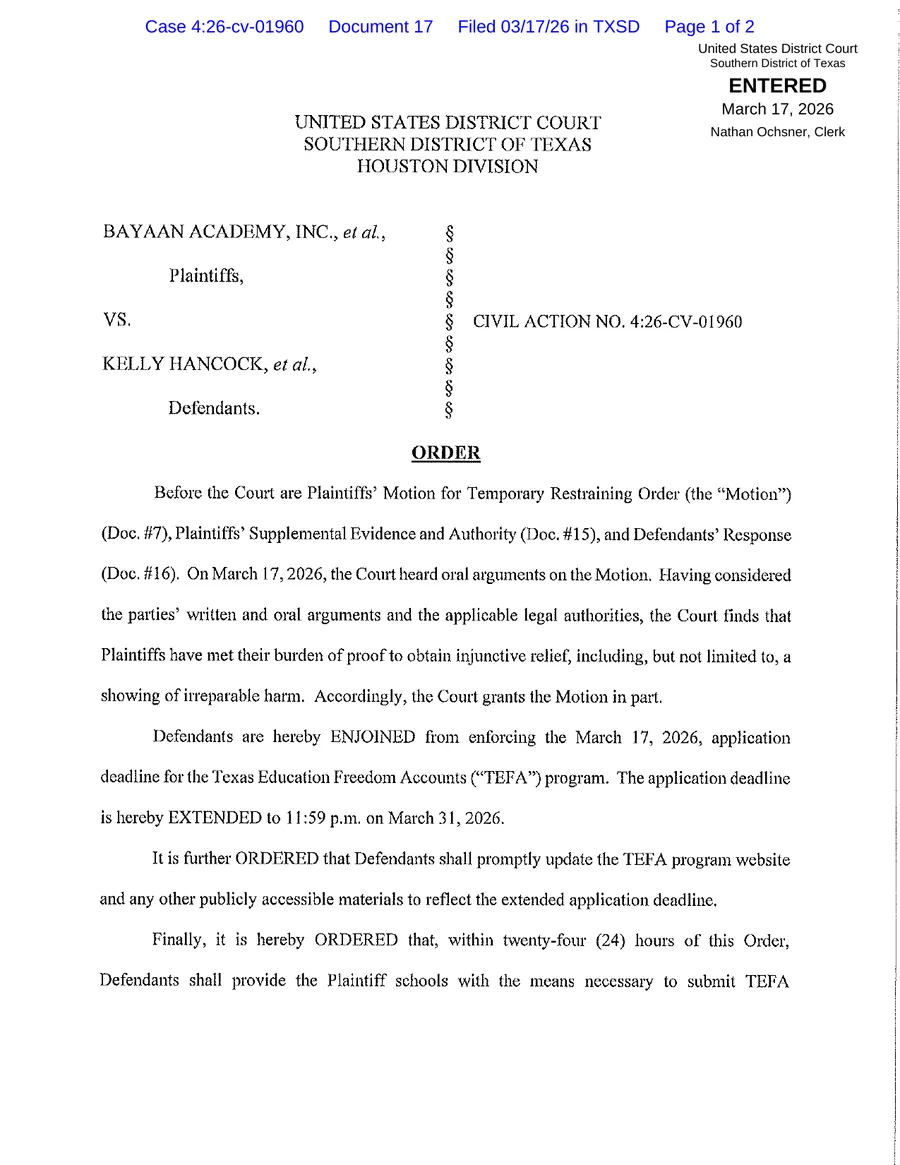
The third dispute moved faster. Texas Education Freedom Accounts, the state’s new private-school funding program, set an application deadline of March 17, 2026. A group of Islamic schools led by Bayaan Academy sued state officials in federal court in Houston. On the day of the deadline, U.S. District Judge Alfred H. Bennett heard arguments and granted a temporary restraining order in part. His two-page order found that the schools had met their burden for emergency relief, including irreparable harm. It barred enforcement of the March 17 deadline, extended it to 11:59 p.m. on March 31, and gave the state 24 hours to provide the plaintiff schools the access they needed to apply, with their applications processed “in the ordinary course.” [7]
The schools then asked for more: fourteen more days of relief and a pause on the program’s lottery until a preliminary-injunction hearing set for April 24. On March 31 the judge said no, and his second order explains why. The first order had rested on a “specific and limited showing” that certain plaintiff schools had been excluded or left pending. The public record now showed the plaintiff schools, and other K-12 Islamic schools, registered and approved. Schools that were not parties, and a class that had not been certified, could not support further emergency relief. [8]
Then the judge added the paragraph that keeps the case from being read as anyone’s victory. The court, he wrote, “underscores that today’s ruling is narrow.” Denying the extension “does not resolve the merits,” and the program remains “subject to constitutional scrutiny.” Read together, the two orders establish that a federal judge found enough to stop a deadline for Islamic schools, then found the emergency over once they were approved. Neither decides whether the state discriminated. [7][8]
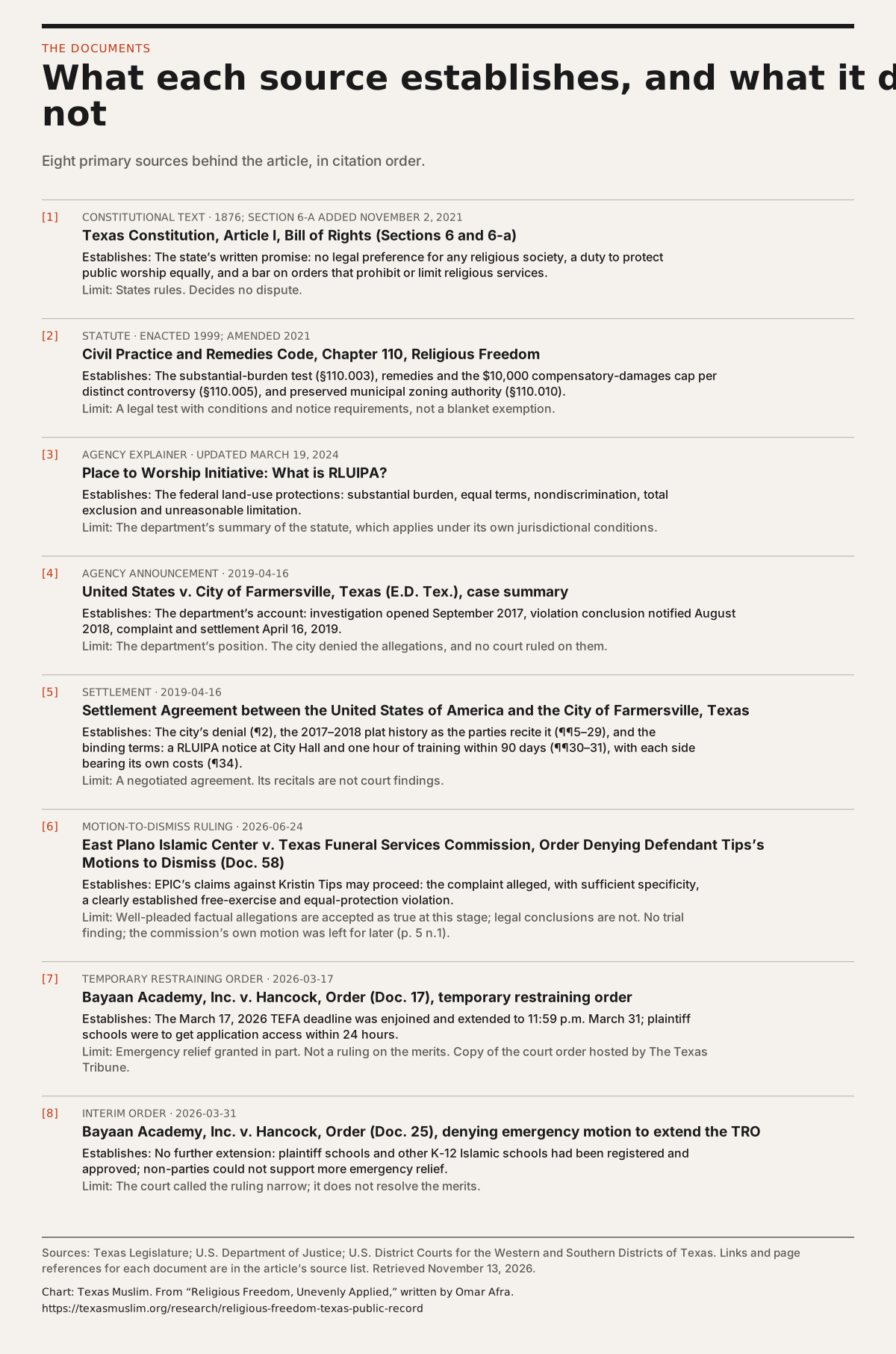
The documents
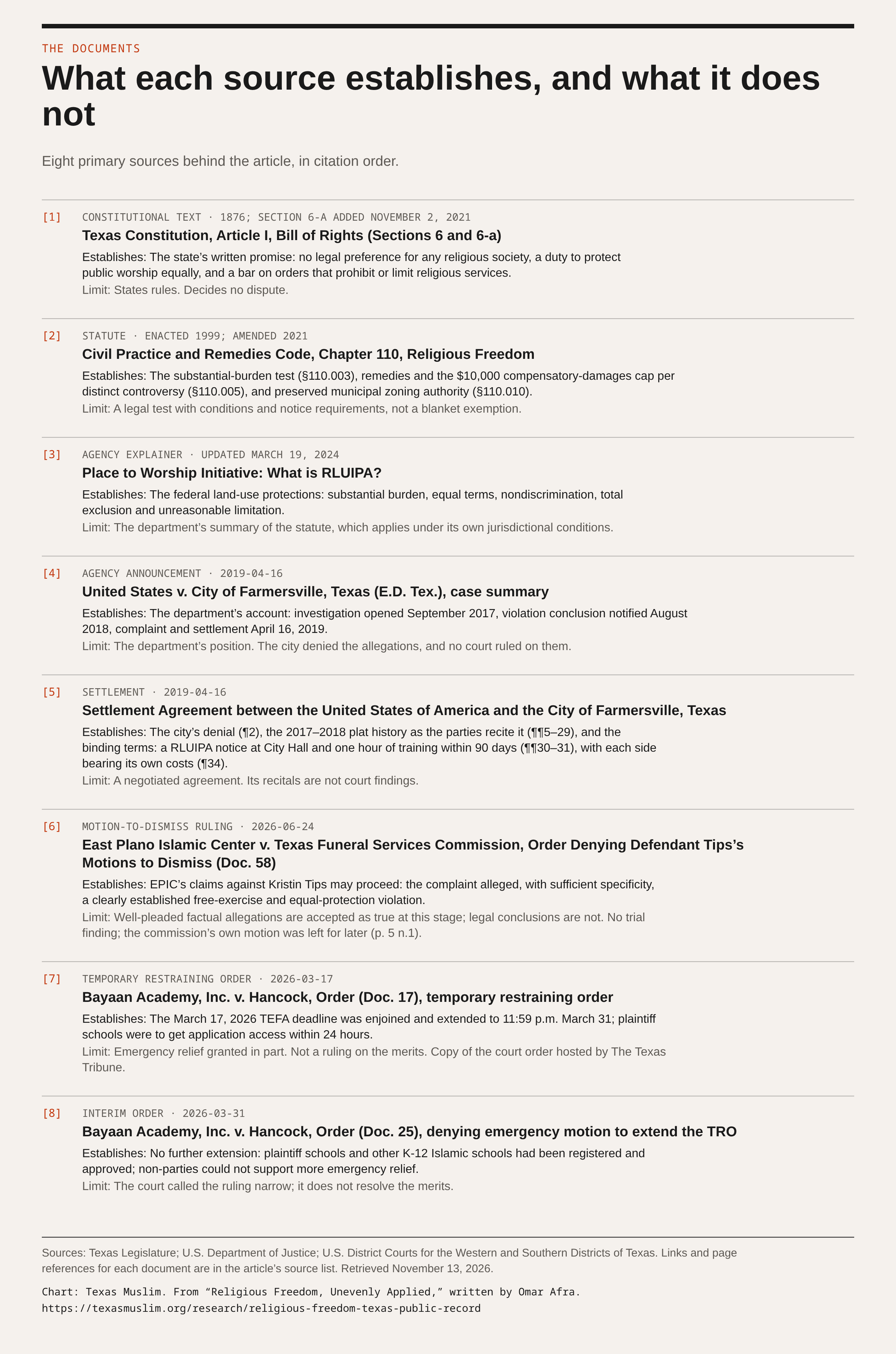
What each source establishes, and what it does not
- [1]
Constitutional text · 1876; Section 6-a added November 2, 2021
Texas Constitution, Article I, Bill of Rights (Sections 6 and 6-a)
Texas Legislature
Establishes The state’s written promise: no legal preference for any religious society, a duty to protect public worship equally, and a bar on orders that prohibit or limit religious services.
Limit States rules. Decides no dispute.
Retrieved November 13, 2026.
- [2]
Statute · Enacted 1999; amended 2021
Civil Practice and Remedies Code, Chapter 110, Religious Freedom
Texas Legislature
Establishes The substantial-burden test (§110.003), remedies and the $10,000 compensatory-damages cap per distinct controversy (§110.005), and preserved municipal zoning authority (§110.010).
Limit A legal test with conditions and notice requirements, not a blanket exemption.
Retrieved November 13, 2026.
- [3]
Agency explainer · Updated March 19, 2024
Place to Worship Initiative: What is RLUIPA?
U.S. Department of Justice, Civil Rights Division
Establishes The federal land-use protections: substantial burden, equal terms, nondiscrimination, total exclusion and unreasonable limitation.
Limit The department’s summary of the statute, which applies under its own jurisdictional conditions.
Retrieved November 13, 2026.
- [4]
Agency announcement · 2019-04-16
United States v. City of Farmersville, Texas (E.D. Tex.), case summary
U.S. Department of Justice, Civil Rights Division
Establishes The department’s account: investigation opened September 2017, violation conclusion notified August 2018, complaint and settlement April 16, 2019.
Limit The department’s position. The city denied the allegations, and no court ruled on them.
Retrieved November 13, 2026.
- [5]
Settlement · 2019-04-16
Settlement Agreement between the United States of America and the City of Farmersville, Texas
U.S. Department of Justice and City of Farmersville
Establishes The city’s denial (¶2), the 2017–2018 plat history as the parties recite it (¶¶5–29), and the binding terms: a RLUIPA notice at City Hall and one hour of training within 90 days (¶¶30–31), with each side bearing its own costs (¶34).
Limit A negotiated agreement. Its recitals are not court findings.
Pages p. 1 Denial of the allegations, ¶2 · p. 3 July 11, 2017 disapproval, ¶10 · p. 7 Notice and training, ¶¶30–31 · p. 8 Each side bears its own costs, ¶34
Retrieved November 13, 2026.
- [6]
Motion-to-dismiss ruling · 2026-06-24
U.S. District Court, Western District of Texas
Establishes EPIC’s claims against Kristin Tips may proceed: the complaint alleged, with sufficient specificity, a clearly established free-exercise and equal-protection violation.
Limit Well-pleaded factual allegations are accepted as true at this stage; legal conclusions are not. No trial finding; the commission’s own motion was left for later (p. 5 n.1).
Pages p. 3 Cease-and-desist letter, March 26, 2025 · p. 4 Rites stopped; clarification letter · p. 5 Separate commission motion, n.1 · p. 26 Conclusion and footnote 6
Retrieved November 13, 2026.
- [7]
Temporary restraining order · 2026-03-17
Bayaan Academy, Inc. v. Hancock, Order (Doc. 17), temporary restraining order
U.S. District Court, Southern District of Texas
Establishes The March 17, 2026 TEFA deadline was enjoined and extended to 11:59 p.m. March 31; plaintiff schools were to get application access within 24 hours.
Limit Emergency relief granted in part. Not a ruling on the merits. Copy of the court order hosted by The Texas Tribune.
Pages p. 1 Deadline enjoined and extended · p. 2 Applications processed in the ordinary course
Retrieved November 13, 2026.
- [8]
Interim order · 2026-03-31
Bayaan Academy, Inc. v. Hancock, Order (Doc. 25), denying emergency motion to extend the TRO
U.S. District Court, Southern District of Texas
Establishes No further extension: plaintiff schools and other K-12 Islamic schools had been registered and approved; non-parties could not support more emergency relief.
Limit The court called the ruling narrow; it does not resolve the merits.
Pages p. 1 Request and governing rule · p. 2 Approvals; ruling is narrow
Retrieved November 13, 2026.
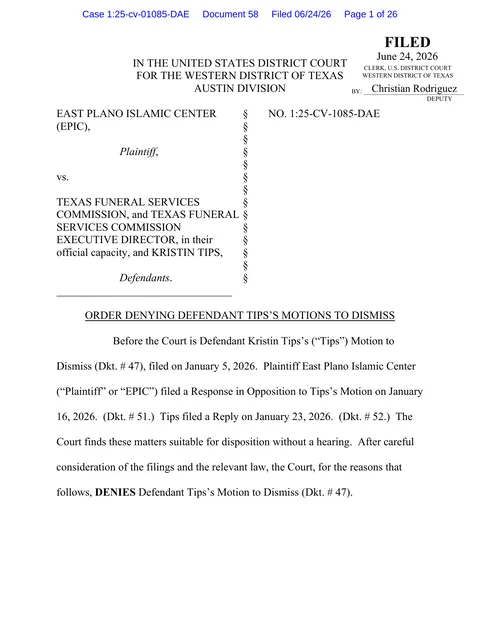
Download this chart
Chart: Texas Muslim. From “Religious Freedom, Unevenly Applied,” written by Omar Afra. Please credit Texas Muslim and link to the article. Sources: Texas Legislature; U.S. Department of Justice; U.S. District Courts. Government texts and court orders are public records.
Read the next headline
Put the three cases side by side and a pattern appears, though not the one either camp usually wants. In each, a Muslim institution’s first answer from a Texas government body was no, or not yet, and the position changed after a federal process was underway: a council reversed itself while an investigation was open, an agency narrowed a letter the day before a hearing, a state program opened its door under a court order. In none of them, in the documents shown here, has a court entered a final judgment that Texas officials discriminated. Both statements are true, and an honest account keeps both. [4][6][7][8]
That is why the documents should be cited by name, date and page. “A judge ruled against Texas” can describe a restraining order that lasted two weeks. “The case was dismissed” can describe a dismissal promised in a settlement whose other party denied everything. “The ruling went the state’s way” can describe a judge declining emergency relief while insisting the merits remain open. When the next dispute arrives, ask which kind of paper is being described, who wrote it and what it decided. The Muslim Tax essay argues what this pattern costs; the religious freedom guide explains the laws in more depth; the EPIC City timeline follows a separate fight over a planned development; and the public record section keeps the wider set of documents in one place. [5][6][8]
About this story
Each statement about a case is tied to a dated primary document and page. Allegations, agency positions, interim orders, settlements and final judgments are labelled as what they are. The documents shown are the ones read for this article; later filings are not described.
Sources
- 1Texas Constitution, Article I, Bill of Rights (Sections 6 and 6-a) — Texas Legislature · retrieved 2026-11-13
- 2Civil Practice and Remedies Code, Chapter 110, Religious Freedom — Texas Legislature · retrieved 2026-11-13
- 3Place to Worship Initiative: What is RLUIPA? — U.S. Department of Justice, Civil Rights Division · retrieved 2026-11-13
- 4United States v. City of Farmersville, Texas (E.D. Tex.), case summary — U.S. Department of Justice, Civil Rights Division · retrieved 2026-11-13
- 5Settlement Agreement between the United States of America and the City of Farmersville, Texas — U.S. Department of Justice and City of Farmersville · retrieved 2026-11-13
- 6East Plano Islamic Center v. Texas Funeral Services Commission, Order Denying Defendant Tips’s Motions to Dismiss (Doc. 58) — U.S. District Court, Western District of Texas · retrieved 2026-11-13
- 7Bayaan Academy, Inc. v. Hancock, Order (Doc. 17), temporary restraining order — U.S. District Court, Southern District of Texas · retrieved 2026-11-13
- 8Bayaan Academy, Inc. v. Hancock, Order (Doc. 25), denying emergency motion to extend the TRO — U.S. District Court, Southern District of Texas · retrieved 2026-11-13
About this work
Omar Afra wrote this analysis from the documents it links. The constitution, statute and court orders are the work of the Legislature and the courts; the settlement is the parties’ document. Page images are reduced copies of those originals, and the timelines and charts are drawn by Texas Muslim from them.
Cite this page
Afra, Omar. “Religious Freedom, Unevenly Applied: Read the Texas Record.” Texas Muslim, November 13, 2026. https://texasmuslim.org/research/religious-freedom-texas-public-record.

About the author
Omar Afra is a Houston-based publisher and the founder and editor of Texas Muslim. He publishes Testset and Live Index and founded Free Press Houston.